
How Negative Self-Talk Destroys Confidence and Mental Health
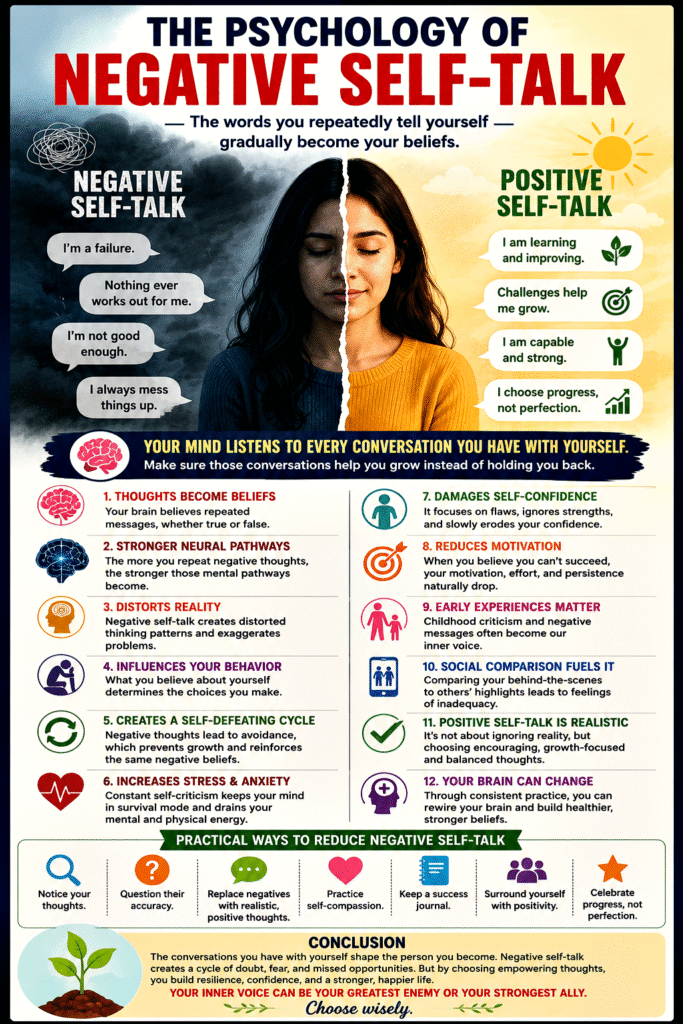
Negative self-talk is one of the most powerful yet overlooked forces that influence our emotions, confidence, relationships, and overall success. Every day, people engage in thousands of internal conversations without even realising it. While some of these thoughts are encouraging, many are critical, fearful, and discouraging.
The encouraging news is that this process works both ways. Just as negative thoughts can weaken confidence, positive and realistic self-talk can strengthen resilience, improve mental health, and unlock personal growth.
Below is a detailed explanation of the psychology of negative self-talk in a point-by-point format.
1. What Is Negative Self-Talk?
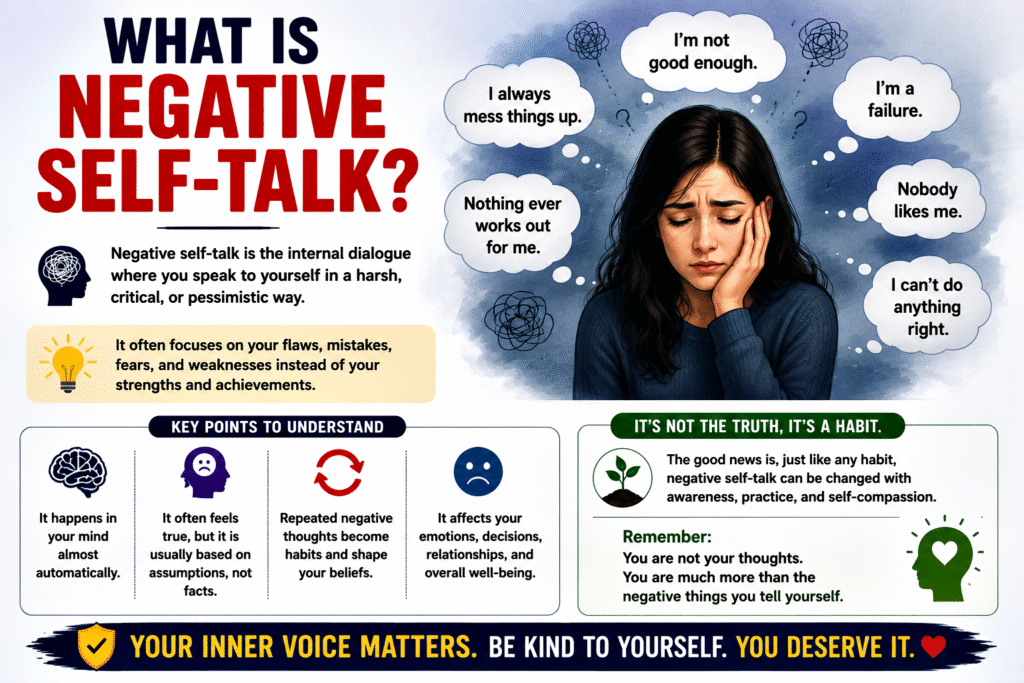
Key Point: Negative self-talk is the habit of speaking to yourself in a harsh, critical, or pessimistic way.
Negative self-talk is the internal dialogue that constantly focuses on mistakes, weaknesses, fears, and worst-case scenarios.
It often sounds like:
- “I’m a failure.”
- “I’m not smart enough.”
- “Nobody likes me.”
- “Nothing ever works out for me.”
- “I’ll probably mess this up.”
These thoughts often become so automatic that people don’t even notice them.
Instead of being based on facts, they are usually based on assumptions, fears, past experiences, or emotional reactions.
Over time, this inner voice becomes louder and more convincing.
2. Your Brain Believes What You Repeatedly Tell It
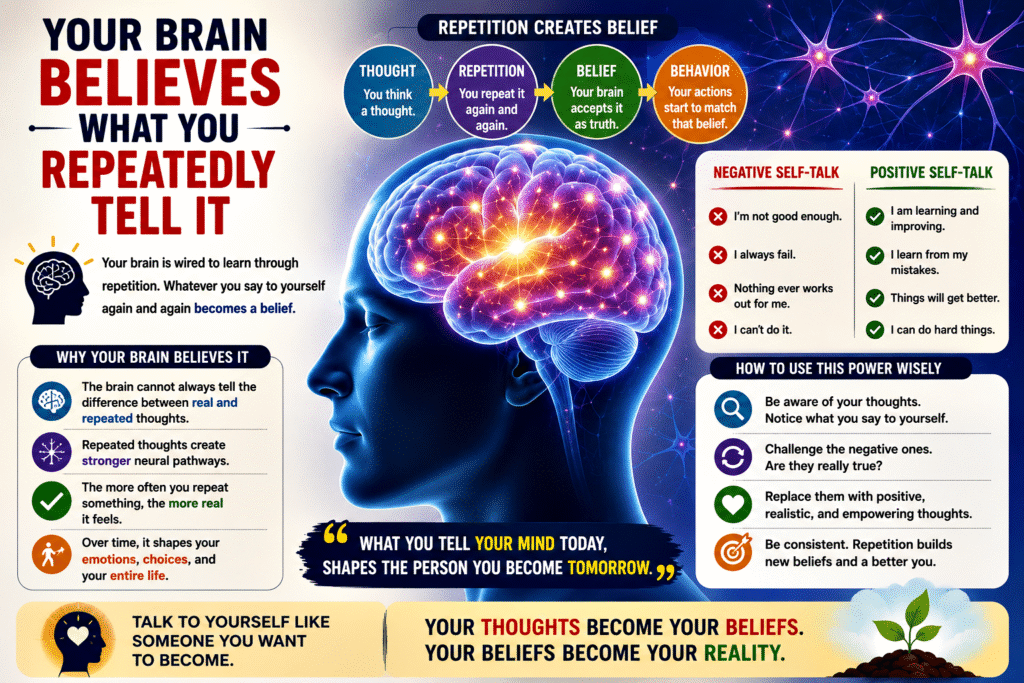
Key Point: Repetition gradually turns thoughts into beliefs.
The human brain is designed to learn through repetition.
Whether you’re learning a language, driving a car, or practicing a musical instrument, repeated actions strengthen neural pathways.
The same principle applies to thoughts.
If you repeatedly think:
- “I’m useless.”
- “I can’t succeed.”
- “I’m unlucky.”
your brain gradually starts accepting these statements as facts.
Eventually, these beliefs become part of your identity.
This psychological process is often referred to as self-reinforcement, where repeated thoughts strengthen themselves over time.
3. Neural Pathways Become Stronger with Repeated Thinking
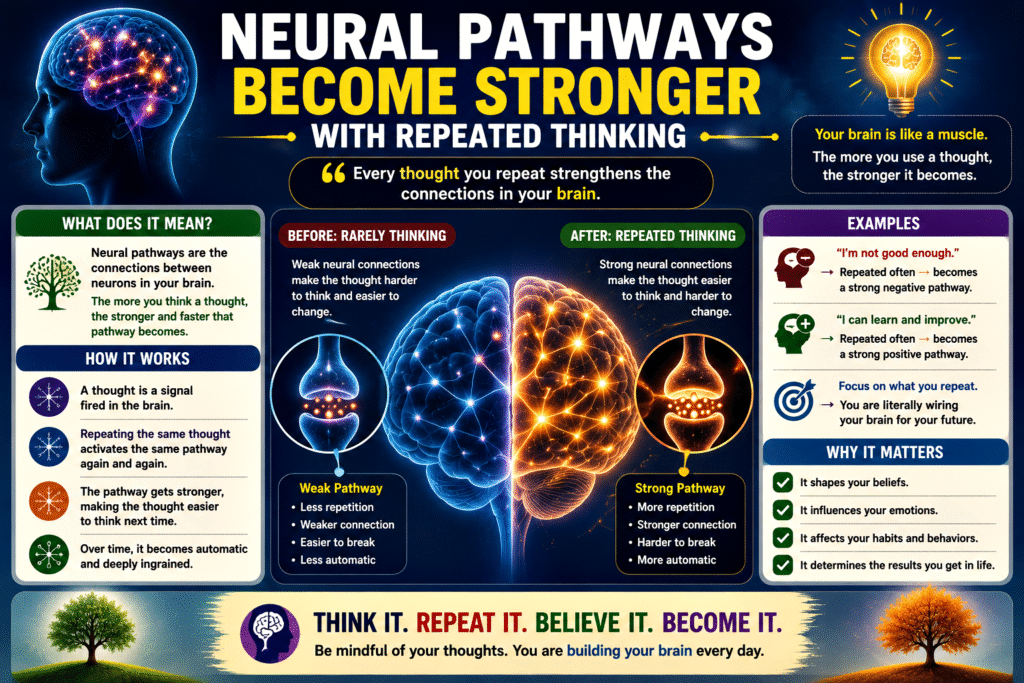
Key Point: Thoughts create mental pathways that become easier to access over time.
Every thought activates certain neurons in your brain.
When those same neurons fire repeatedly, they develop stronger connections.
Psychologists summarize this concept with the phrase:
“Neurons that fire together, wire together.”
This means:
- Negative thoughts become easier to think.
- Self-criticism becomes automatic.
- Optimistic thinking becomes more difficult.
Eventually, your brain begins choosing negative interpretations without conscious effort.
This is why breaking negative thinking patterns requires consistent practice.
4. Negative Self-Talk Distorts Reality
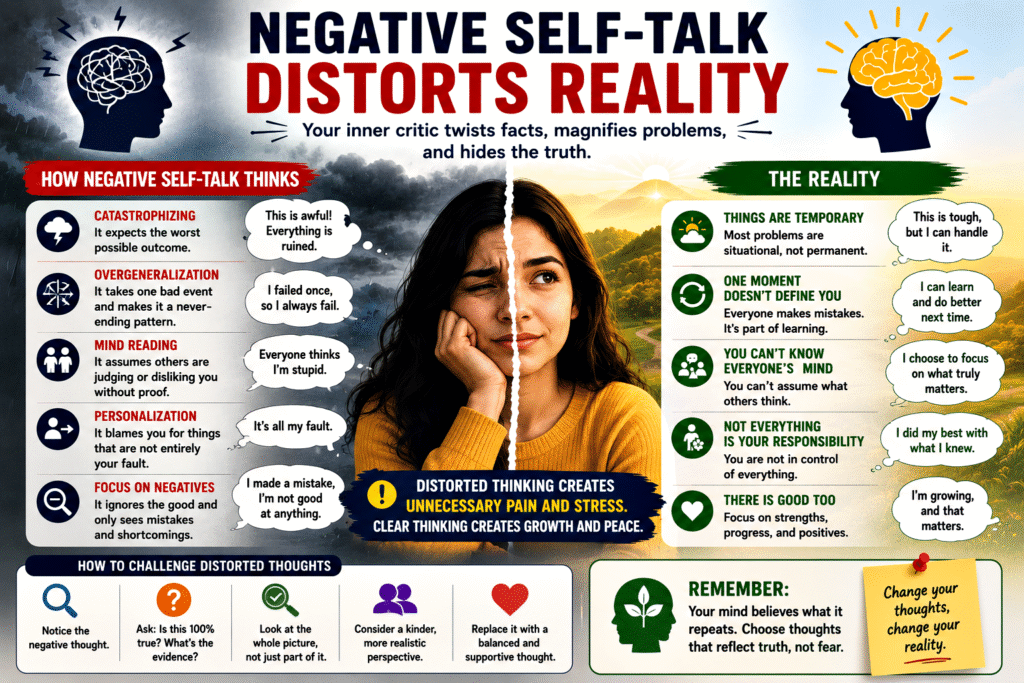
Key Point: Your inner critic often exaggerates problems and ignores facts.
Negative self-talk rarely reflects reality accurately.
Instead, it tends to create distorted thinking patterns such as:
- Catastrophizing (“Everything is ruined.”)
- Overgeneralization (“I failed once, so I’ll always fail.”)
- Mind reading (“Everyone thinks I’m stupid.”)
- Personalization (“Everything is my fault.”)
These mental distortions make ordinary setbacks seem much worse than they actually are.
Instead of seeing temporary challenges, the brain starts seeing permanent failure.
5. Your Beliefs Influence Your Behavior
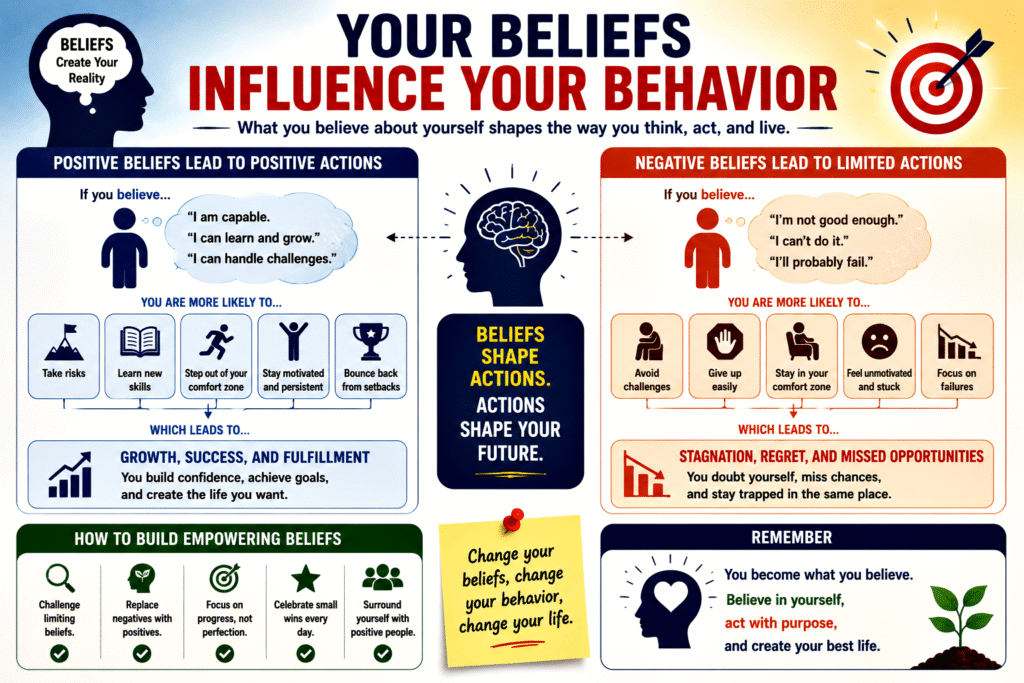
Key Point: What you believe about yourself determines how you act.
People naturally behave according to their beliefs.
If someone believes:
“I am capable.”
they are more likely to:
- Take risks
- Try new opportunities
- Learn new skills
- Recover from setbacks
But if someone believes:
“I’m not good enough.”
they often:
Self-Talk: The belief—not necessarily the ability—becomes the biggest obstacle.
6. Negative Self-Talk Creates a Self-Fulfilling Prophecy
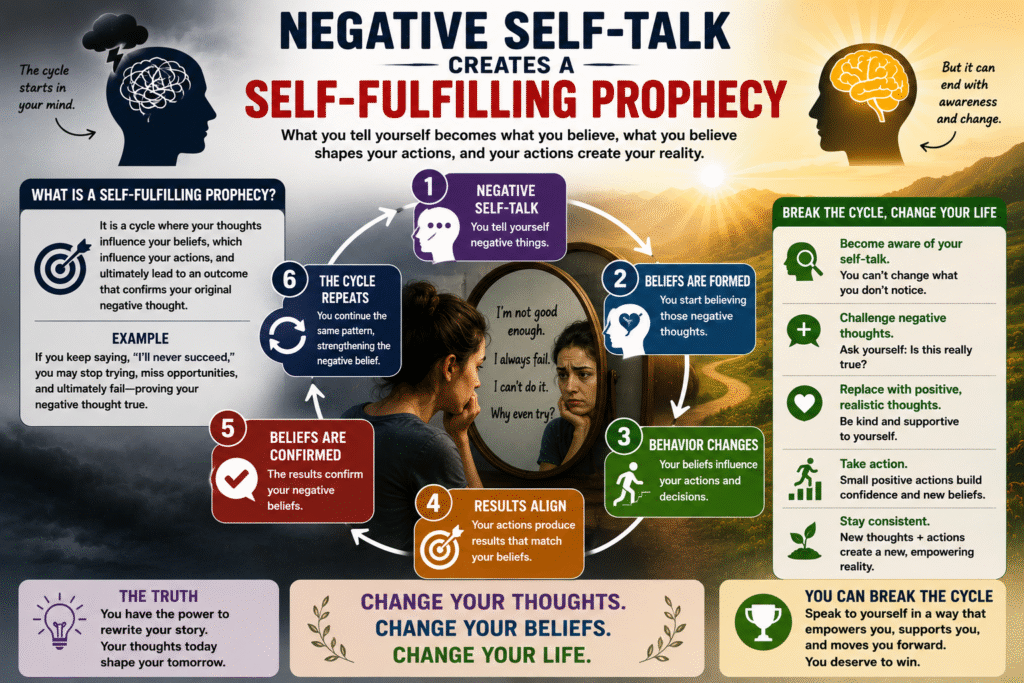
Key Point: Your expectations often influence your outcomes.
Imagine someone thinking:
“I’m definitely going to fail this interview.”
Because of this belief, they may:
- Prepare less
- Feel nervous
- Speak with less confidence
- Avoid eye contact
Their poor performance increases the chance of rejection.
The rejection then appears to “prove” the original belief.
This creates a self-fulfilling prophecy.
The thought caused behaviors that produced the expected outcome.
7. The Self-Defeating Cycle
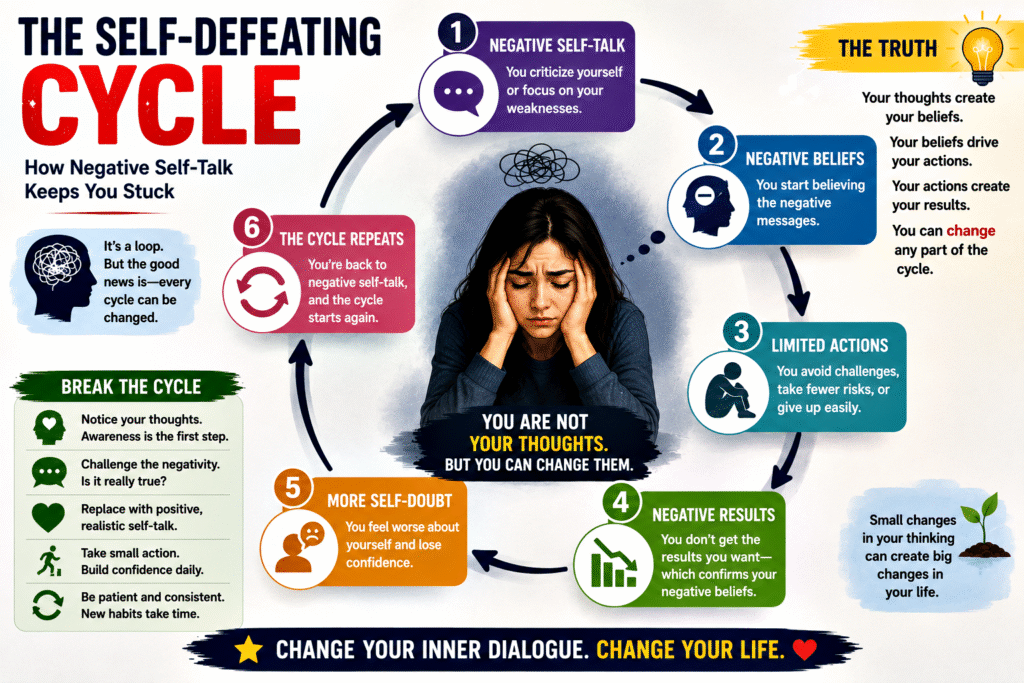
Key Point: Negative thoughts create behaviors that reinforce those same thoughts.
A typical cycle looks like this:
- You believe you’re incapable.
- You avoid difficult situations.
- You gain less experience.
- Your skills improve slowly.
- You feel unsuccessful.
- The original belief becomes stronger.
This cycle can continue for years unless consciously interrupted.
The problem isn’t always lack of ability—it is often lack of belief.
8. Negative Self-Talk Increases Stress and Anxiety
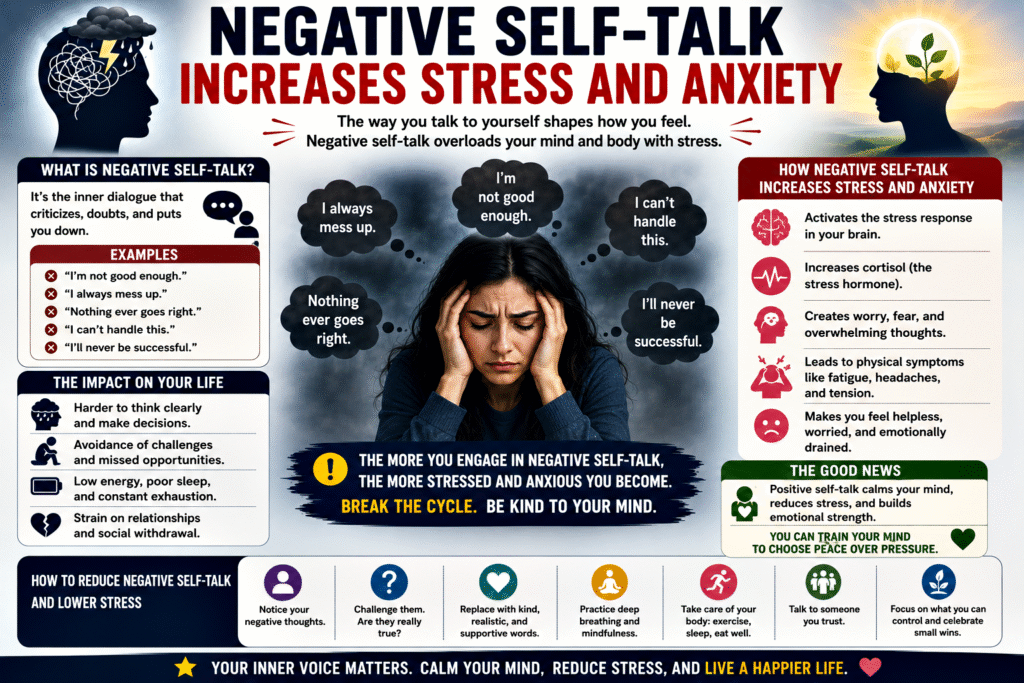
Key Point: Constant self-criticism keeps the brain in survival mode.
When your internal dialogue is filled with fear and criticism, your brain interprets these thoughts as threats.
This activates the body’s stress response.
As a result:
- Cortisol levels increase.
- Anxiety becomes stronger.
- Sleep quality declines.
- Emotional exhaustion grows.
Even in safe situations, your mind behaves as if danger is present.
Living in this constant state of mental tension drains both emotional and physical energy.
9. It Damages Self-Confidence
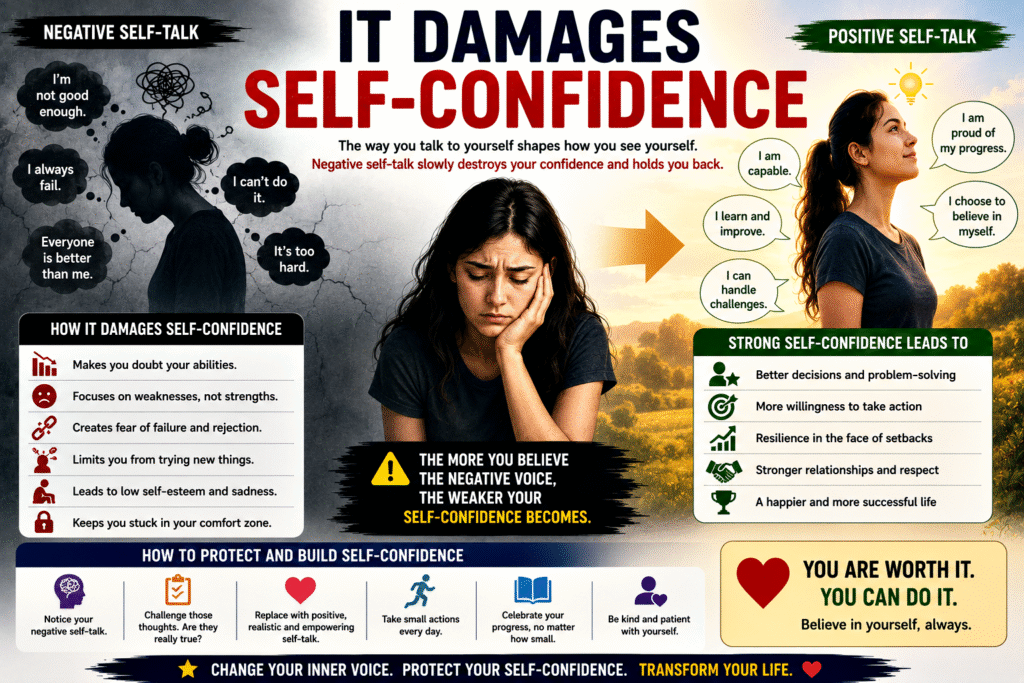
Key Point: Confidence is built through supportive inner dialogue.
Confidence isn’t simply believing you’re perfect.
It’s believing that you can handle challenges, learn from mistakes, and improve over time.
Negative self-talk slowly erodes this confidence by constantly highlighting flaws while ignoring strengths.
People begin doubting themselves even when they have the necessary skills.
This unnecessary self-doubt limits personal and professional growth.
10. It Reduces Motivation
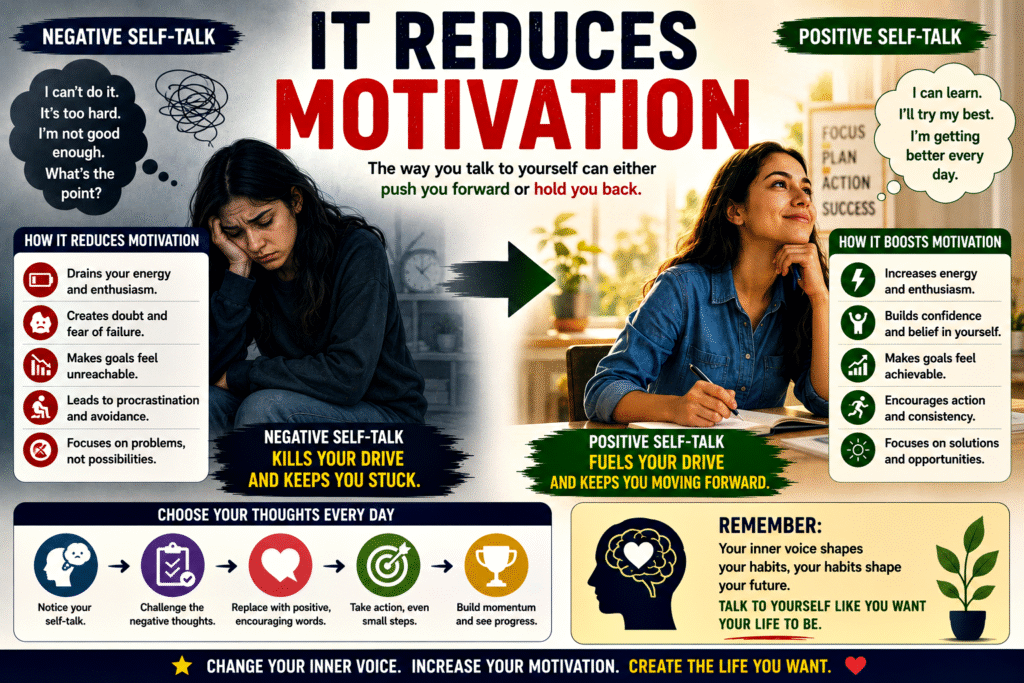
Key Point: People rarely work hard toward goals they believe are impossible.
Motivation depends heavily on expectation.
If you believe:
“I’ll never succeed.”
your brain asks:
“Why even try?”
As motivation decreases:
- Effort decreases.
- Persistence decreases.
- Learning slows.
- Success becomes less likely.
This is another example of negative beliefs creating negative outcomes.
11. Childhood Experiences Often Shape Self-Talk
Key Point: Many negative beliefs begin early in life.
Children absorb messages from:
- Parents
- Teachers
- Friends
- Siblings
- Society
Repeated criticism like:
- “You’re lazy.”
- “You’re not smart.”
- “You’ll never succeed.”
can eventually become the child’s own internal voice.
As adults, many people continue repeating these old messages without questioning whether they are true.
Recognising the origin of these beliefs is the first step toward changing them.
12. Social Comparison Makes Negative Self-Talk Worse
Key Point: Comparing your behind-the-scenes with someone else’s highlights is unfair.
Social media often encourages unrealistic comparisons.
People compare:
- Their appearance
- Income
- Relationships
- Careers
- Achievements
to carefully edited versions of other people’s lives.
This fuels thoughts such as:
- “Everyone is doing better than me.”
- “I’m falling behind.”
- “I’m not successful.”
Frequent comparison strengthens feelings of inadequacy and dissatisfaction.
13. Positive Self-Talk Doesn’t Mean Ignoring Reality
Key Point: Healthy self-talk is realistic, not unrealistic.
Positive self-talk isn’t pretending everything is perfect.
Instead of saying:
“I’m the best.”
healthy thinking sounds like:
- “I can improve.”
- “I’m learning.”
- “Mistakes help me grow.”
- “This challenge is difficult, but I can handle it.”
These statements acknowledge reality while encouraging progress.
This balanced mindset builds lasting confidence.
14. Replacing Negative Thoughts Strengthens New Neural Pathways
Key Point: Your brain can rewire itself through consistent practice.
The brain has an amazing ability called neuroplasticity, meaning it can reorganize itself by forming new neural connections.
Every time you replace:
“I’m terrible at this.”
with
“I’m still learning.”
you strengthen healthier thinking patterns.
At first, this feels unnatural because old neural pathways are stronger.
But repeated practice gradually makes encouraging thoughts more automatic.
Small daily changes eventually create lasting mental habits.
15. Practical Ways to Reduce Negative Self-Talk
Key Point: Awareness and consistent practice can transform your inner dialogue.
Here are some effective strategies:
Notice Your Thoughts
Pay attention to recurring negative statements instead of accepting them automatically.
Question Their Accuracy
Ask yourself:
- Is this thought based on facts?
- What evidence supports it?
- What evidence contradicts it?
Replace Absolutes
Instead of:
“I always fail.”
Say:
“I’ve failed before, but I’ve also succeeded.”
Practice Self-Compassion
Speak to yourself the way you would encourage a close friend.
Keep a Success Journal
Write down daily achievements, compliments, and moments of progress to remind yourself of your strengths.
Surround Yourself with Positive Influences
Supportive people, uplifting books, podcasts, and communities can reinforce healthier beliefs.
Celebrate Progress, Not Perfection
Focus on consistent improvement rather than flawless performance.
16. Build an Inner Coach Instead of an Inner Critic
Key Point: The goal is not silence, but support.
Everyone has an inner voice. The question is whether that voice discourages or empowers you.
An inner critic says:
- “You’re not good enough.”
An inner coach says:
- “You made a mistake, but you can learn from it.”
An inner critic focuses on failure.
An inner coach focuses on growth.
Over time, cultivating an encouraging inner coach leads to greater resilience, confidence, and emotional well-being.
Conclusion
Key Point: The conversations you have with yourself shape the person you become.
Negative self-talk may seem harmless because it happens silently, but its effects are profound. Every repeated thought leaves an imprint on the brain, strengthening beliefs that influence emotions, behaviors, and life choices. When you constantly tell yourself that you’re incapable, your actions begin to reflect that belief, creating a cycle of avoidance, self-doubt, and missed opportunities.
Remember, your inner voice is always listening—and so is your brain. Make that voice one that inspires growth, celebrates progress, and reminds you that mistakes are stepping stones, not definitions of who you are. The words you repeatedly tell yourself today will become the beliefs that shape your tomorrow, so choose them wisely.