Plato’s Cave Theory Explained in the Easiest Way
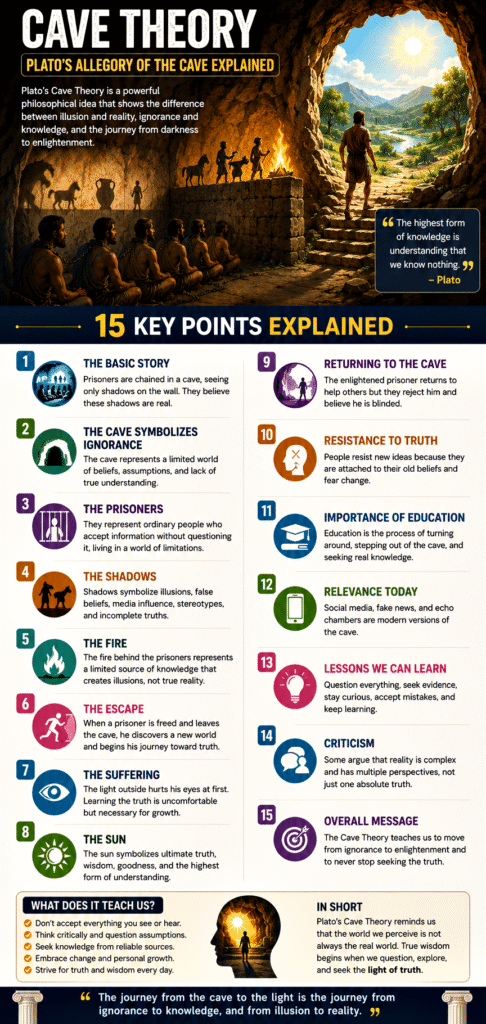
The Cave Theory, more accurately known as Plato’s Allegory of the Cave, is one of the most famous philosophical ideas in history. It was introduced by the Greek philosopher Plato in his work The Republic around 380 BCE. The allegory is a symbolic story that explains the difference between appearance and reality, ignorance and knowledge, and illusion and truth.
Even though it was written more than 2,000 years ago, the Cave Theory is surprisingly relevant today. In an age of social media, misinformation, artificial intelligence, and digital entertainment, many people unknowingly mistake appearances for reality—just as the prisoners in Plato’s cave did.
Below is a detailed explanation in pointwise form.
1. The Basic Story of the Cave
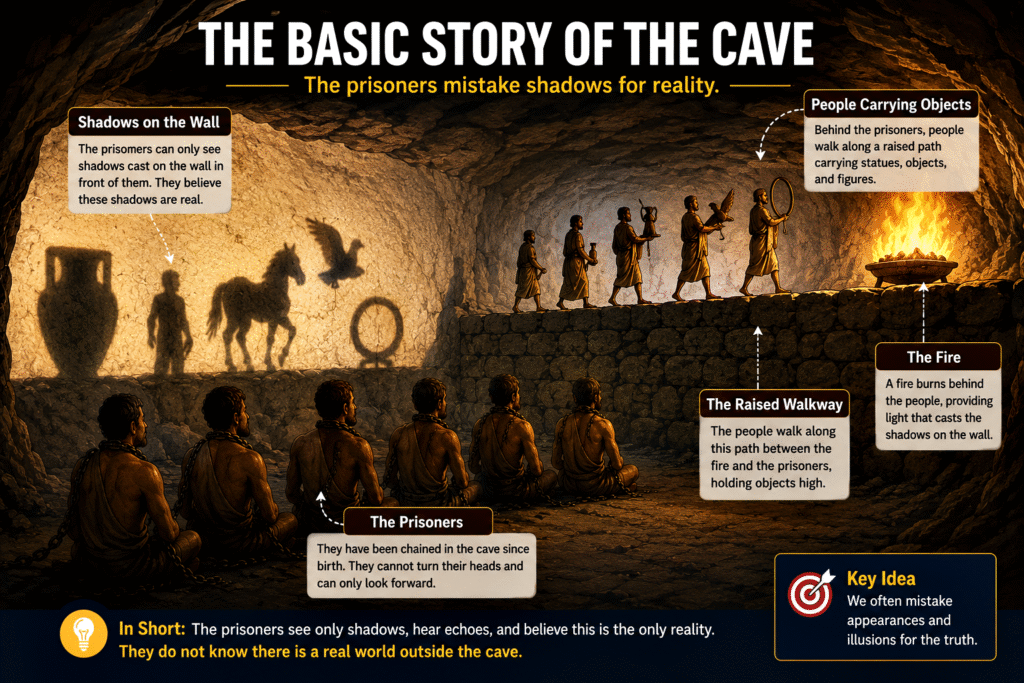
Key Point: The cave represents a world where people mistake illusions for reality.
Plato asks us to imagine a group of people who have been chained inside a dark cave since birth. These prisoners are unable to turn their heads and can only look straight ahead.
Behind them burns a fire, and between the fire and the prisoners is a raised walkway. People walk along this path carrying statues, objects, and figures. These objects cast shadows on the wall in front of the prisoners.
Since the prisoners have never seen anything else, they believe these shadows are real objects. The echoes inside the cave even make them think the shadows are speaking.
For them, the shadow world is the only reality they know.
This story serves as a metaphor for how humans often accept incomplete or false information without questioning it.
2. What Does the Cave Symbolise?
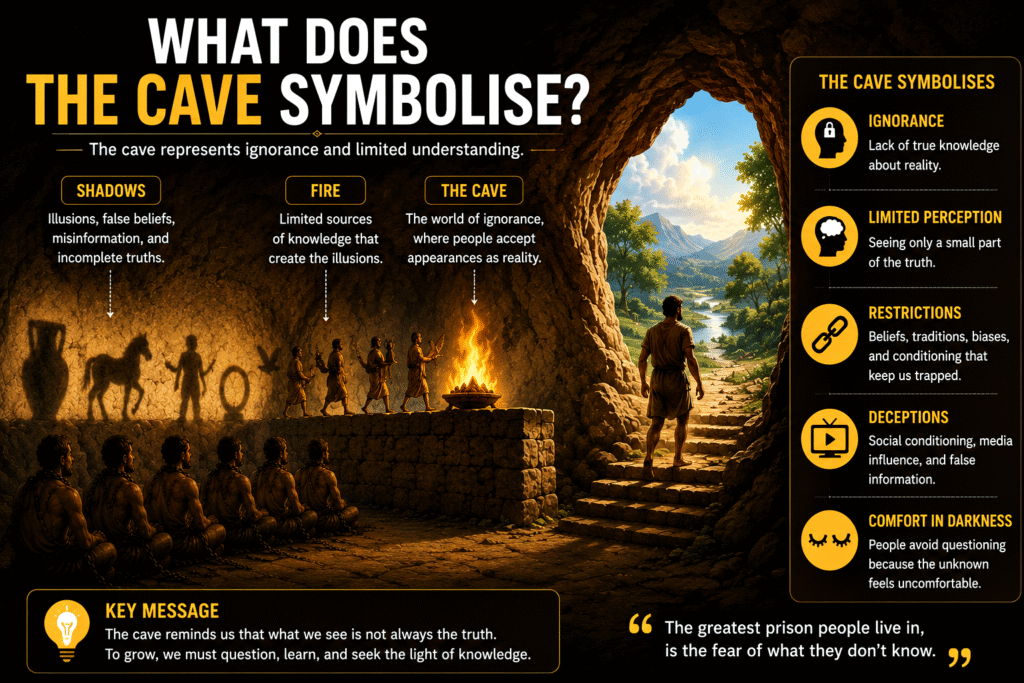
Key Point: The cave symbolises ignorance and limited understanding.
The cave is not just a physical place. It represents a person’s limited perception of reality.
People often live inside their own “mental caves” created by:
- Wrong beliefs
- Social conditioning
- Cultural traditions
- Media influence
- Personal biases
- Lack of education
Many people accept ideas simply because everyone else believes them.
The cave reminds us that reality is often much larger than what we immediately see.
3. Who Are the Prisoners?
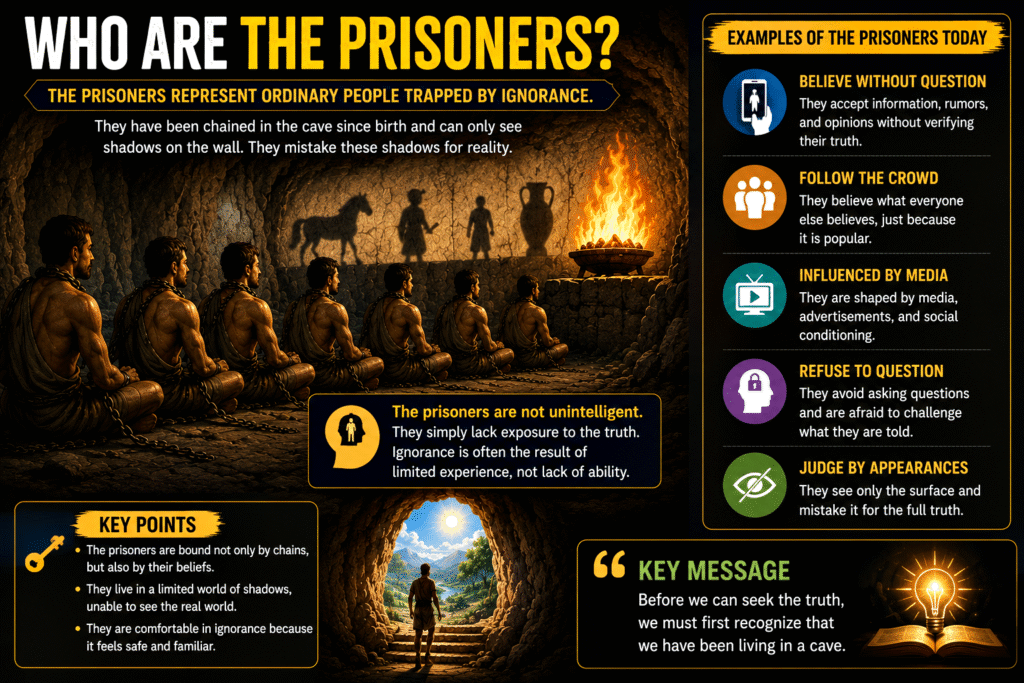
Key Point: The prisoners represent ordinary people trapped by ignorance.
The prisoners symbolize individuals who never question their beliefs.
Examples include people who:
- Believe every rumor they hear
- Trust misinformation without verification
- Judge others based on appearances
- Refuse to learn new ideas
- Avoid critical thinking
The prisoners are not unintelligent—they simply lack exposure to the truth.
This shows that ignorance is often the result of limited experience rather than lack of ability.
4. What Do the Shadows Represent?
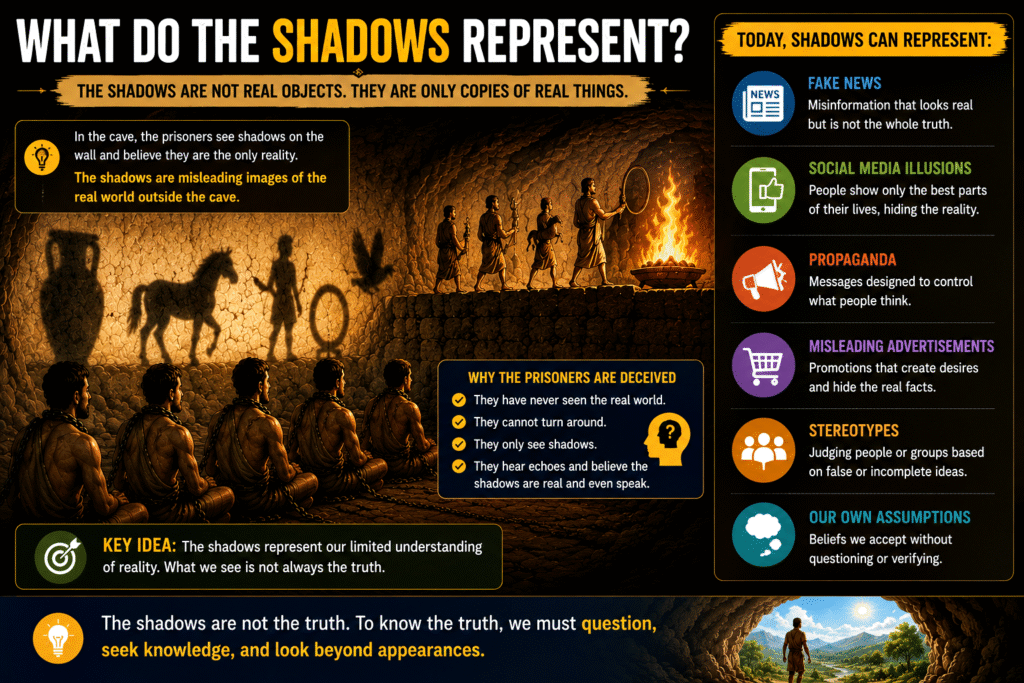
Key Point: The shadows symbolize illusions and incomplete truths.
The shadows are copies of real objects, but the prisoners mistake them for reality itself.
Today, shadows can represent:
- Fake news
- Edited social media lives
- Propaganda
- Stereotypes
- Misleading advertisements
- False assumptions
Many things people accept as facts are actually only partial truths.
Plato reminds us to look beyond appearances.
5. The Fire Behind the Prisoners
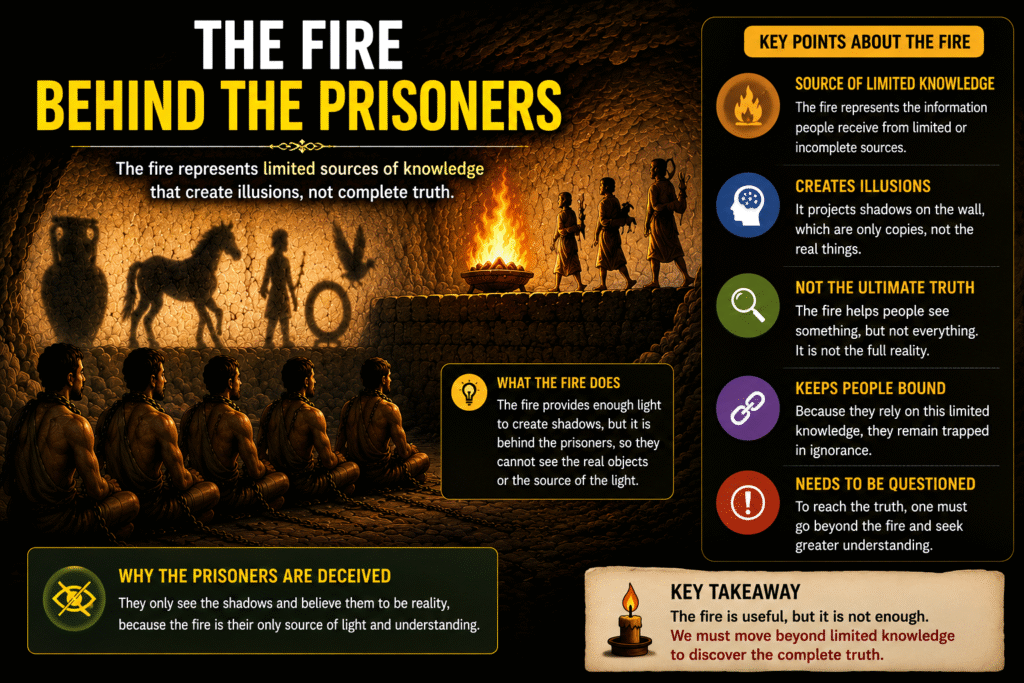
Key Point: The fire represents limited sources of knowledge.
The fire provides enough light to create shadows but not enough to reveal reality.
Similarly, many people rely on incomplete sources of information.
Examples include:
- One-sided news
- Biased opinions
- Limited education
- Personal assumptions
The fire produces knowledge, but it is not complete knowledge.
True understanding requires moving beyond the fire.
6. The Escape from the Cave
Key Point: Education begins when someone questions accepted beliefs.
Imagine one prisoner is suddenly freed.
At first, he struggles because his eyes have adjusted to darkness.
When he turns around, he sees the fire and realizes the shadows were never real.
As he leaves the cave, the sunlight hurts his eyes.
Gradually, however, he begins to see:
- Trees
- Mountains
- Animals
- Rivers
- The sky
He discovers the real world for the first time.
This painful journey symbolizes learning and intellectual growth.
7. Why Does the Prisoner Suffer?
Key Point: Learning the truth is often uncomfortable.
People naturally resist change.
When long-held beliefs are challenged, individuals may experience:
- Confusion
- Fear
- Doubt
- Anxiety
- Resistance
This discomfort is part of personal growth.
Just as muscles grow through exercise, the mind grows through questioning.
8. The Sun Represents Ultimate Truth
Key Point: The sun symbolizes wisdom, truth, and ultimate knowledge.
Outside the cave, the prisoner eventually sees the sun.
Plato believed the sun represents the highest form of reality.
The sun symbolizes:
- Truth
- Wisdom
- Knowledge
- Goodness
- Enlightenment
Without sunlight, objects cannot be seen clearly.
Similarly, without truth, people cannot fully understand reality.
9. Returning to the Cave
Key Point: Enlightened people often struggle to convince others.
After discovering reality, the freed prisoner returns to rescue the others.
However, something unexpected happens.
Because his eyes have adjusted to sunlight, he initially struggles to see in the darkness again.
The prisoners laugh at him.
They believe leaving the cave has damaged his eyesight.
Instead of listening, they reject him.
This demonstrates that people often reject ideas that challenge their worldview.
10. Why Do People Resist the Truth?
Key Point: Familiar beliefs feel safer than uncomfortable truths.
People resist truth because it threatens their identity.
Reasons include:
- Fear of change
- Social pressure
- Confirmation bias
- Emotional attachment
- Pride
- Habit
Changing one’s beliefs requires humility.
Plato believed wisdom begins when we admit we may be wrong.
11. The Importance of Education
Key Point: Education is the path from darkness to light.
Plato saw education as much more than memorizing facts.
True education teaches people to:
- Think independently
- Analyze evidence
- Ask questions
- Challenge assumptions
- Seek truth
Education transforms how people think, not just what they know.
12. Cave Theory in Today’s World
Key Point: Modern technology creates new forms of the cave.
The Cave Theory is especially relevant today.
Examples include:
- Social media echo chambers
- Fake news websites
- Deepfake videos
- AI-generated misinformation
- Celebrity culture
- Online conspiracy theories
Many people consume only information that supports their existing opinions.
This creates a modern version of Plato’s cave.
Critical thinking is more important than ever.
13. Lessons We Can Learn from the Cave Theory
Key Point: Personal growth begins by questioning assumptions.
Plato’s allegory encourages us to:
- Verify information before believing it.
- Read from multiple reliable sources.
- Stay curious throughout life.
- Accept that we may be mistaken.
- Respect evidence over opinions.
- Welcome constructive criticism.
- Keep learning continuously.
- Avoid judging solely by appearances.
By doing these things, we gradually leave our own “caves.”
14. Criticism of the Cave Theory
Key Point: Some philosophers argue that reality is more complex than Plato suggested.
While the allegory is influential, it has also been criticized.
Common criticisms include:
- People may experience multiple valid perspectives rather than one absolute truth.
- Reality can be interpreted differently depending on culture, science, and personal experience.
- Knowledge evolves over time, so what is considered “truth” today may change with new evidence.
- The theory may underestimate the value of practical experience compared with abstract reasoning.
Even so, the allegory remains valuable because it encourages intellectual humility and lifelong learning.
Conclusion
Plato’s Cave Theory is much more than an ancient philosophical story. It is a timeless lesson about the difference between illusion and reality, ignorance and wisdom, and passive acceptance and critical thinking.
The cave represents the limitations created by habit, misinformation, and unquestioned beliefs. The shadows symbolize appearances that can deceive us, while the journey out of the cave represents education, curiosity, and the courage to seek the truth. The sun stands for ultimate understanding, and the return to the cave reminds us that new ideas are often met with scepticism.
In today’s world—where information is abundant but not always accurate—the allegory is more relevant than ever. It encourages us to question what we see, evaluate evidence carefully, remain open to new perspectives, and continue learning throughout life. By doing so, we move closer to genuine understanding and avoid becoming prisoners of illusion.