

Why We Often Realise Someone’s Value Too Late
The Psychology of Familiarity, Appreciation, and Human Relationships
We often appreciate something most when we are about to lose it. This is especially true in relationships. A supportive friend, caring partner, loving family member, helpful colleague, or dependable person can become such a normal part of our lives that we gradually stop noticing the value they bring.
This doesn’t necessarily mean that we don’t love or care about these people. Sometimes, familiarity simply makes extraordinary things feel ordinary.
Psychology can help explain why this happens—and, more importantly, how we can become better at appreciating the people who make our lives meaningful.
1. The Psychology of Familiarity and Habituation
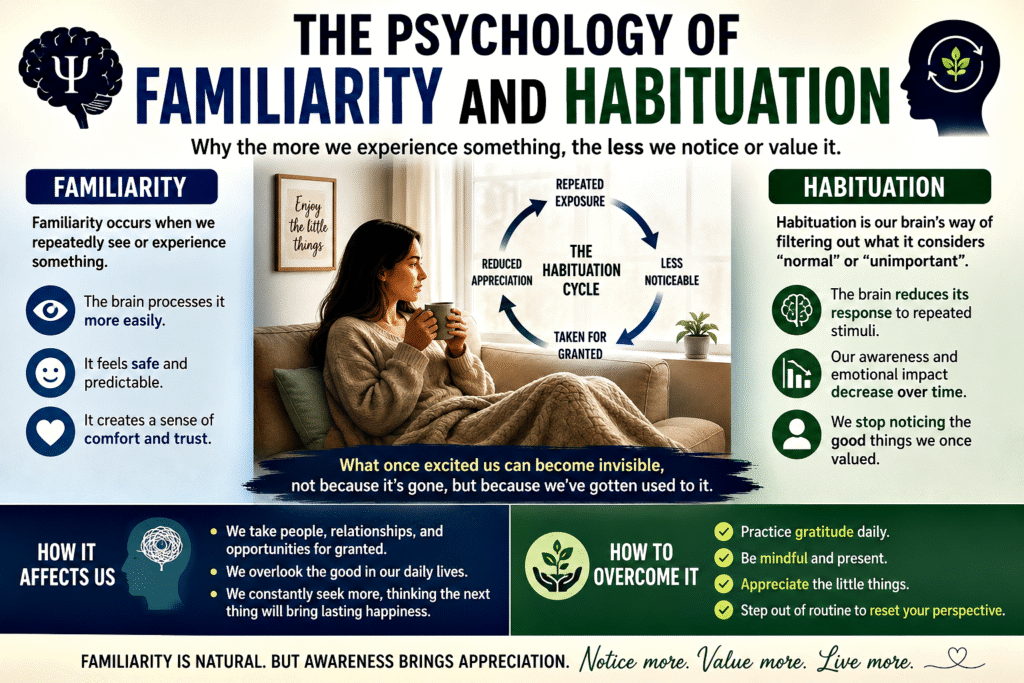
Key Point: When something becomes familiar, our brains often stop paying conscious attention to it.
Human beings naturally adapt to repeated experiences. Psychologists often refer to this process as habituation. When we repeatedly encounter the same stimulus, our response to it can gradually decrease.
This happens with relationships too.
Think about the first time someone goes out of their way to help you. You may feel deeply grateful. You remember the gesture and perhaps tell other people about it.
But if that person helps you repeatedly, something strange can happen.
The first favour feels special.
The tenth favour feels normal.
Eventually, you may stop noticing it altogether.
The person hasn’t necessarily become less caring. Your attention has simply adapted to their consistent behaviour.
This can happen with:
- A parent who constantly supports you
- A partner who always checks on you
- A friend who listens whenever you’re struggling
- A colleague who repeatedly helps you
- A family member who is always available
- Someone who regularly encourages your ambitions
Their reliability becomes so predictable that you stop recognizing how valuable it actually is.
Lesson:
Familiarity can reduce our awareness of someone’s value without reducing the value they provide.
2. Why Constant Availability Can Become Invisible

Key Point: When someone is always available, we may mistake their reliability for an obligation.
One of the easiest ways to take someone for granted is to become accustomed to their availability.
You know they will answer your call.
You know they’ll listen.
You know they’ll help.
You know they’ll forgive you.
You know they’ll be there.
That certainty feels comforting—but it can also become dangerous if it causes you to stop appreciating their effort.
Sometimes we unconsciously assume:
“They’ll always be there.”
That sentence sounds reassuring, but it contains an important assumption: always.
People have limits. They have their own responsibilities, emotions, difficulties, and needs.
Someone who constantly supports you may also be dealing with problems you don’t see.
When we treat their availability as automatic, we may stop asking:
- “How are you doing?”
- “Do you need anything?”
- “Have I thanked you recently?”
- “Am I also supporting you?”
- “Do they feel appreciated?”
Healthy relationships require reciprocity. A person shouldn’t have to disappear before we realize how much they contributed to our lives.
Lesson:
Someone’s willingness to be there for you is a gift, not a permanent obligation.
3. How Routine Affects Appreciation
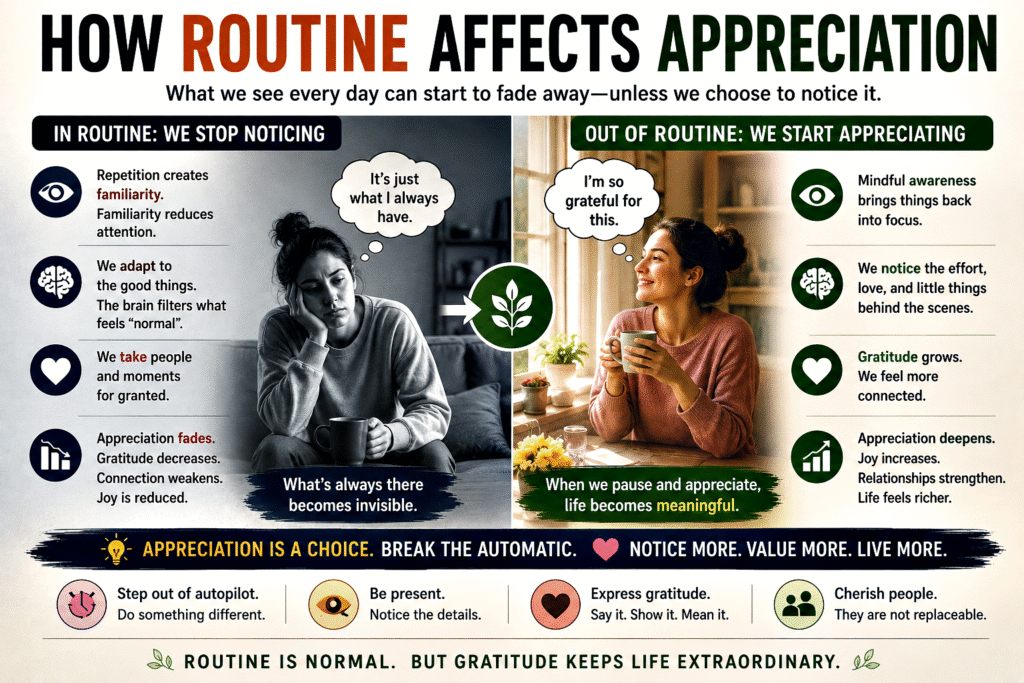
Key Point: Routine creates comfort, but it can also hide the extraordinary things happening in everyday life.
Relationships naturally develop routines.
You talk regularly.
You have meals together.
You exchange messages.
You celebrate birthdays.
You help each other with everyday responsibilities.
Over time, these experiences can become predictable.
And predictable experiences often receive less conscious attention.
This is one reason people sometimes remember the beginning of a relationship more vividly than its everyday middle. Early experiences are new and emotionally stimulating. Later experiences become familiar.
But familiarity doesn’t mean something has lost its meaning.
In fact, some of the most valuable things in life are repetitive:
- Someone asking whether you reached home safely
- Someone remembering your favorite food
- Someone checking on you when you’re sick
- Someone encouraging you after failure
- Someone listening to the same problem repeatedly
- Someone standing beside you during difficult periods
These actions may appear small, but repeated small acts of care can create extraordinary emotional security.
Lesson:
Don’t allow routine to make you blind to the small acts of love and kindness that make your life better.
4. Why We Sometimes Recognise Someone’s Value Only After Losing Them

Key Point: Absence can make invisible contributions suddenly visible.
One of the most painful lessons people sometimes learn is someone’s value after that person is no longer present.
When a person leaves, the everyday things they did become noticeable.
You suddenly realize:
“They were the person I called whenever something went wrong.”
“They always encouraged me.”
“They were the one who remembered the little things.”
“I never realized how much they did for me.”
Their absence changes your perspective.
This happens because their contributions were previously embedded within your everyday routine. Once the routine disappears, the gap becomes obvious.
However, not every relationship can be restored after someone leaves. People move away. Circumstances change. Relationships end. And sometimes people pass away.
That is why appreciation should happen before absence forces us to understand someone’s importance.
Instead of waiting for a goodbye to recognize someone’s value, pay attention while they are still beside you.
Lesson:
Don’t let someone’s absence teach you the value that their presence was already demonstrating.
5. Taking Someone for Granted Can Slowly Damage a Relationship

Key Point: Being consistently unappreciated can make even a strong relationship emotionally exhausting.
Taking someone for granted isn’t always about deliberately mistreating them.
Sometimes it looks like:
- Never saying thank you
- Assuming they will always help
- Only contacting them when you need something
- Ignoring their efforts
- Expecting emotional support without offering it in return
- Forgetting important things about their life
- Becoming irritated when they establish boundaries
Over time, the other person may begin to feel invisible.
They may think:
“Does anything I do matter?”
“Would they even notice if I stopped trying?”
When these feelings accumulate, emotional distance can develop.
A person who has spent years giving support may eventually stop—not because they stopped caring, but because they became exhausted from giving without feeling valued.
Lesson:
Appreciation isn’t merely about making someone feel good; it helps maintain emotional balance within relationships.
6. Appreciate Effort, Not Just Results

Key Point: People need recognition for the thought, time, and effort behind their actions—not just their outcomes.
Sometimes we only appreciate visible results.
We thank someone when they achieve something impressive, solve a major problem, or do something extraordinary.
But many meaningful contributions are invisible.
A person may spend hours listening to you.
Someone may quietly worry about you.
A friend may rearrange their schedule to help.
A parent may make sacrifices you never fully notice.
A partner may repeatedly compromise for the relationship.
These efforts may never appear dramatic, but they still matter.
Instead of only recognizing outcomes, learn to notice intentions and effort.
You can say:
“I appreciate how much effort you put into this.”
“Thank you for always listening to me.”
“I noticed what you did for me.”
“I don’t say it often enough, but I really appreciate having you in my life.”
Such statements can have enormous emotional impact.
Lesson:
Sometimes the most powerful appreciation is simply letting someone know that their effort has been noticed.
7. Don’t Confuse Appreciation With Dependency
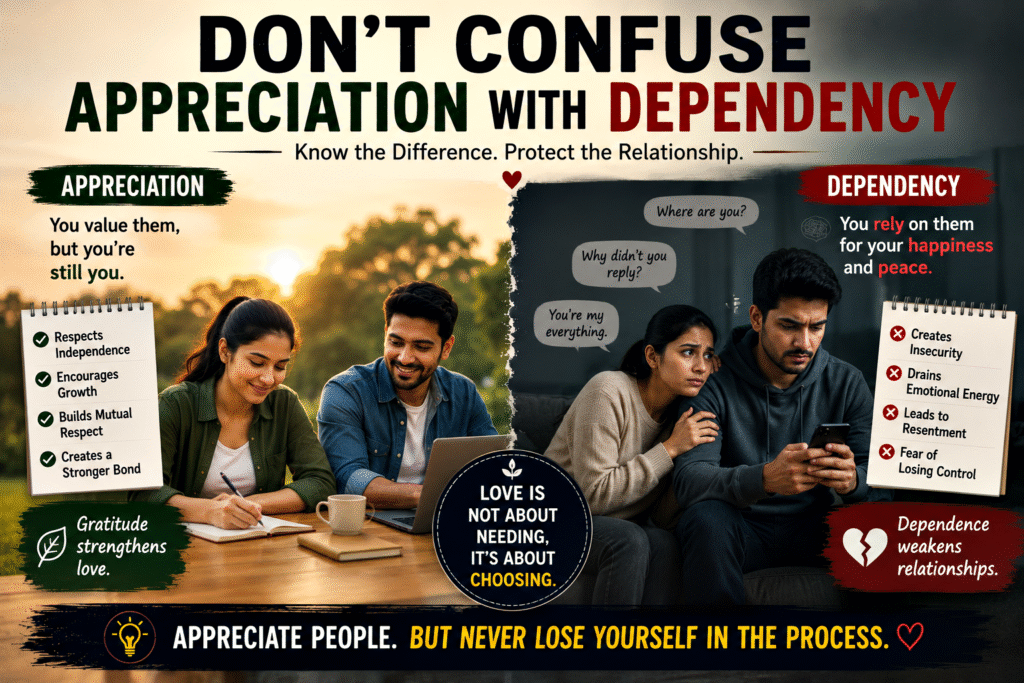
Key Point: Appreciating someone doesn’t mean becoming completely dependent on them.
Healthy appreciation doesn’t mean expecting another person to solve all your problems.
In fact, relationships become stronger when both people maintain their own identity, responsibilities, and boundaries.
You can appreciate someone without assuming they must always be available.
You can love someone without demanding constant attention.
You can value someone’s support while also learning to support yourself.
This distinction matters because excessive dependence can eventually turn appreciation into entitlement.
A healthy relationship sounds like:
“I value what you do for me.”
An unhealthy relationship can become:
“You should always do this for me.”
The first expresses gratitude.
The second creates expectation.
Lesson:
Appreciation says, “I value you.” Entitlement says, “You owe me.” Know the difference.
8. Practical Ways to Appreciate People Before It’s Too Late
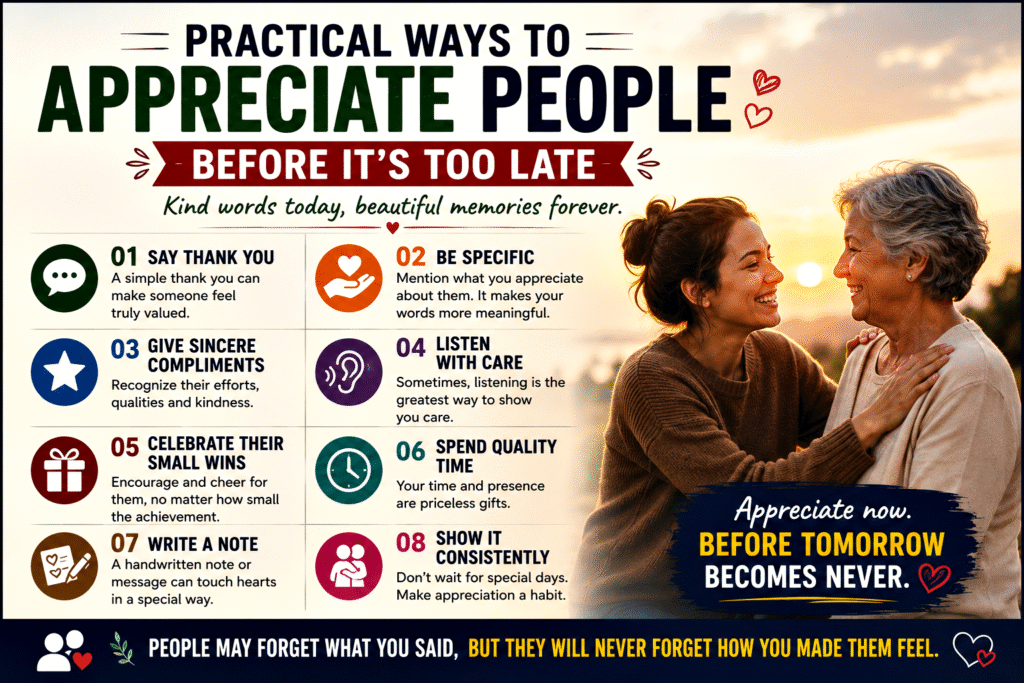
Key Point: Appreciation becomes meaningful when it is expressed through consistent actions.
You don’t need grand gestures to make someone feel valued.
Small actions can communicate enormous appreciation.
Say Thank You Specifically
Instead of simply saying “thanks,” explain what you appreciate.
For example:
“Thank you for listening to me when I was struggling. It really helped.”
Specific appreciation feels more genuine.
Check on People Without Needing Anything
Don’t contact someone only when you need advice, help, or a favor.
Sometimes simply asking:
“How are you doing?”
can strengthen a relationship.
Remember the Small Things
Remember their important dates, interests, goals, challenges, and achievements.
Remembering demonstrates attention.
Return the Support
If someone is always there for you, make an effort to be there for them too.
Ask:
“What can I do for you?”
Give Genuine Compliments
Tell people what you admire about them.
Don’t assume they already know.
Spend Quality Time Together
Presence is one of the most meaningful forms of appreciation.
Put away distractions and give people your full attention.
Apologize When You Are Wrong
Appreciation also means respecting someone’s feelings.
A sincere apology can repair emotional distance before it becomes permanent.
Lesson:
Don’t just feel grateful for the people you love—show them that you are grateful.
9. Learn to Notice the People Who Quietly Make Your Life Better

Key Point: Some of the most important people in our lives are not the loudest or most visible.
Not every important relationship is dramatic.
Sometimes the people who matter most are those who quietly show up.
They don’t constantly announce what they do.
They simply:
- Answer the phone
- Remember your struggles
- Celebrate your achievements
- Offer honest advice
- Give you another chance
- Encourage you when you doubt yourself
- Stay when life becomes difficult
These people may not demand recognition.
That doesn’t mean they don’t deserve it.
Take a moment to think about the people who have made your life easier, happier, or stronger.
Ask yourself:
“Have I told them how much they mean to me?”
If the answer is no, you don’t have to wait for a special occasion.
Tell them today.
Lesson:
The people who quietly support you may be among the greatest blessings in your life. Don’t let their quietness make them invisible.
Conclusion
Key Point: Appreciate people while their presence is still part of your everyday life.
Taking good people for granted is a surprisingly human behavior. Familiarity makes their presence predictable, routine makes their efforts less noticeable, and constant availability can make their support feel automatic.
But people are not permanent fixtures in our lives.
Relationships change.
Circumstances change.
People move.
Priorities change.
Sometimes relationships end unexpectedly.
The painful truth is that we may not always get another opportunity to say thank you.
That’s why appreciation shouldn’t be postponed.
Notice the person who always checks on you.
Notice the friend who listens.
Notice the family member who supports you.
Notice the colleague who helps you.
Notice the person who believes in you when you don’t believe in yourself.
And then express your gratitude.
You don’t need an elaborate gift or a dramatic speech. Sometimes a sincere message, a thoughtful gesture, a phone call, or simply saying “I appreciate you” is enough.
Final Takeaway
Don’t wait for someone’s absence to reveal their importance.
Don’t wait for a goodbye to say thank you.
Don’t let familiarity turn someone’s kindness into something invisible.
The people who consistently make your life better deserve to know that their presence matters.
Appreciate them while they’re still part of your story. Because one day, you may look back and realize that the ordinary moments you barely noticed were actually some of the most valuable moments of your life.