
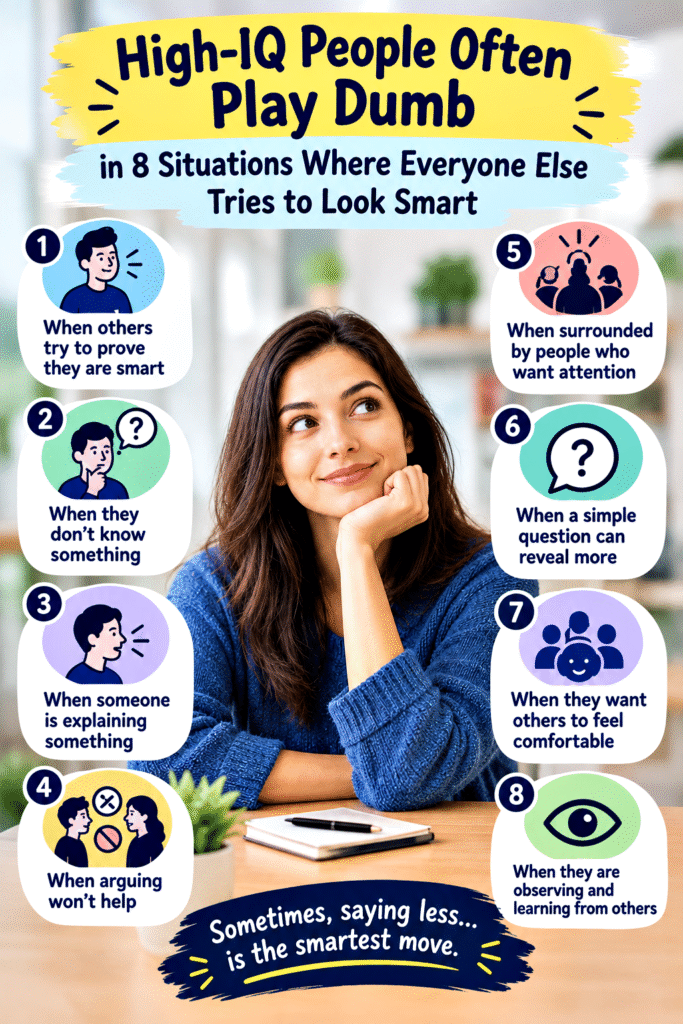
8 Signs of Intelligence That May Look Like Playing Dumb
Intelligence is not always about showing how much you know. In fact, people with strong reasoning abilities may sometimes choose not to display their intelligence. They understand that proving they are the smartest person in the room is often less useful than listening, observing, asking questions, or allowing others to speak.
Of course, not every intelligent person behaves this way, and “playing dumb” does not necessarily mean having a high IQ. It can simply be a social strategy, emotional skill, or sign of confidence.
Here are eight situations where someone may deliberately appear less knowledgeable than they actually are.
1. When Someone Is Trying Too Hard to Prove They Are Smart

In many conversations, people feel pressure to demonstrate their knowledge. They may interrupt others, use complicated words, quote facts, or quickly provide answers.
A person who is genuinely knowledgeable may not feel the same need.
High-IQ people may deliberately stay quiet because they don’t need constant validation. They understand that intelligence does not become greater simply because other people recognize it.
Instead of competing to answer first, they may listen carefully and allow the conversation to develop naturally.
For example, if someone asks a question and another person immediately gives an elaborate answer, the intelligent person may already know the answer but choose to listen rather than compete for attention.
Key point: Real confidence often reduces the need to prove intelligence.
2. When They Don’t Know Something
Intelligent people generally understand how enormous human knowledge really is. They know that being highly knowledgeable in one area does not make someone knowledgeable about everything.
Therefore, they may comfortably say:
“I don’t know.”
This can sometimes make them appear less intelligent to people who believe smart people should have an answer for everything.
But admitting ignorance can actually be a sign of intellectual honesty.
Instead of inventing an answer, they may ask questions, research the subject, or listen to someone with greater expertise.
Someone who pretends to know everything can make mistakes. Someone willing to admit what they don’t know has an opportunity to learn.
Key point: Intelligent people are often comfortable admitting what they don’t know.
3. When Someone Is Explaining Something They Already Understand
Imagine someone explaining a familiar subject to them in great detail.
They could interrupt and say, “I already know that.”
But sometimes they don’t.
They allow the other person to finish because understanding someone else’s thinking can be more valuable than demonstrating their own knowledge.
They may even ask simple questions, despite already knowing the answer, because those questions encourage the other person to explain their reasoning.
This can make conversations more comfortable and productive.
It also prevents unnecessary competition.
Key point: Listening can be more valuable than demonstrating that you already know the answer.
4. When Arguing Would Accomplish Nothing
Not every disagreement deserves a debate.
Some people feel compelled to correct every inaccurate statement they hear. Intelligent people may recognise that being correct and being productive are not always the same thing.
If the subject is unimportant, the relationship matters more than winning the argument, or the other person clearly isn’t interested in changing their opinion, they may simply let the conversation go.
This doesn’t necessarily mean they agree.
They may simply decide that continuing the argument isn’t worth the time or emotional energy.
Key point: Knowing when not to argue can be more useful than knowing how to win an argument.
5. When They Are Surrounded by People Who Want Attention
Some environments encourage people to compete for attention.
Everyone wants to tell the best story, give the fastest answer, or demonstrate the most impressive knowledge.
An intelligent person may deliberately step back.
Instead of competing for the spotlight, they observe the people around them.
They may notice who dominates conversations, who listens, who exaggerates, who changes their behaviour depending on the audience, and who genuinely understands the subject being discussed.
This quiet observation can provide information that is easily missed when someone is busy trying to impress others.
Sometimes the person saying the least is actually paying the most attention.
Key point: Staying quiet can give an intelligent person more opportunity to observe and understand.
6. When Asking a “Simple” Question Helps Them Understand More
One interesting behaviour of intelligent people is that they may ask questions that appear extremely basic.
Why?
Because simple questions can reveal complicated assumptions.
Suppose a group is discussing a difficult technical problem. Everyone is using sophisticated terminology, but nobody has questioned the basic assumption behind the problem.
Someone might ask:
“Why are we doing it this way in the first place?”
That seemingly simple question can completely change the discussion.
Intelligent people often understand that asking questions isn’t a sign of weakness. It can be a powerful way to uncover information.
They may deliberately appear uninformed so that people explain their reasoning in greater detail.
Key point: A simple question can sometimes uncover a problem that complicated thinking has overlooked.
7. When They Want Other People to Feel Comfortable
Intelligence without social awareness can sometimes make conversations uncomfortable.
If someone constantly corrects others, uses advanced terminology, or demonstrates superior knowledge, people may become defensive.
A socially intelligent person may therefore adjust their behaviour to make others feel comfortable.
They might simplify their language, ask the other person for their opinion, or allow them to explain something they already understand.
This isn’t necessarily deception.
It can simply be a form of social awareness.
The goal is not always to demonstrate what you know. Sometimes the goal is to create an environment where everyone feels comfortable contributing.
Key point: Social intelligence means knowing when to demonstrate knowledge and when to make space for others.
8. When They Are Watching and Learning From Others
Perhaps the most interesting situation occurs when an intelligent person deliberately takes the role of the learner.
They may already understand much of the subject, but instead of immediately revealing their knowledge, they ask questions and observe.
They use the conversation as an opportunity to collect information.
This can be especially useful in unfamiliar environments.
By appearing curious rather than authoritative, they may encourage people to reveal more about their ideas, experiences, assumptions, and knowledge.
They can then evaluate the information quietly.
This approach is particularly useful when entering a new workplace, meeting unfamiliar people, negotiating, or trying to understand a complicated situation.
Key point: Sometimes appearing less knowledgeable creates more opportunities to learn.
Final Thought
The idea that “high-IQ people play dumb” should not be taken literally. IQ measures certain cognitive abilities; it does not automatically determine personality, humility, social intelligence, or behaviour.
However, there is a useful lesson behind the idea.
A person doesn’t have to demonstrate intelligence in every conversation. Sometimes the smarter approach is to listen instead of interrupting, ask instead of assuming, observe instead of competing, and admit uncertainty instead of pretending to know everything.
The person who constantly tries to look intelligent may attract attention. The person who quietly understands what is happening may gain something more valuable: knowledge, perspective, and better judgment.
True intelligence is not only about knowing the answer. It is also about knowing when to speak, when to listen, and when saying less is the wiser choice.