
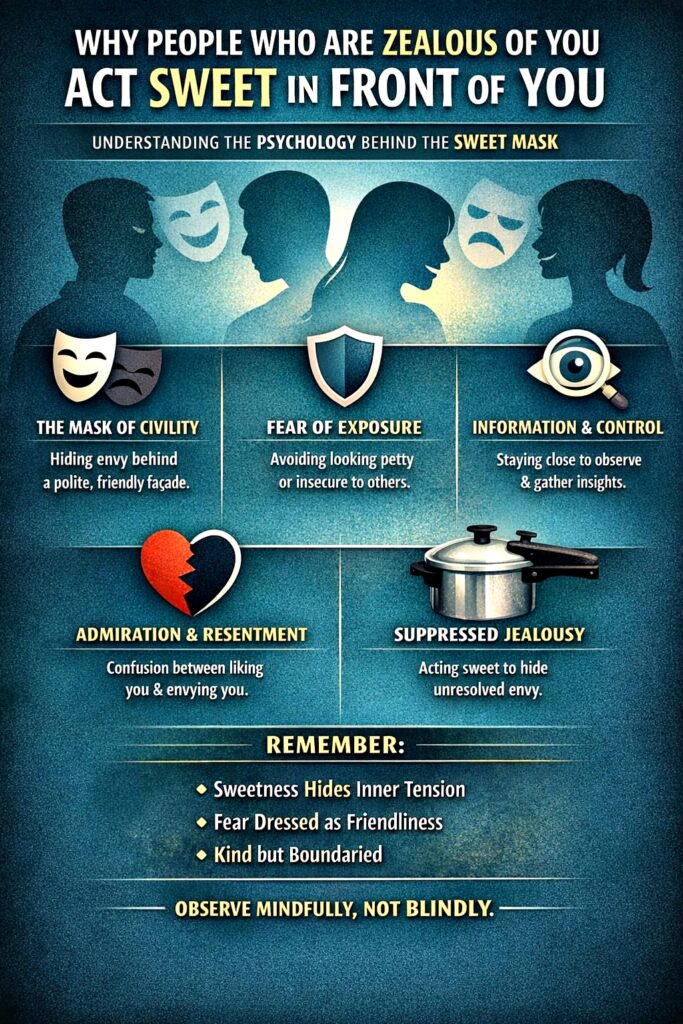
The Hidden Psychology of Sweet Behaviour Driven by Jealousy
That’s a sharp observation—and a very real human pattern. People who feel zealous (jealous, envious, threatened, or quietly competitive) toward you often don’t show hostility openly. Instead, they wear a mask of sweetness. This behaviour isn’t accidental; it’s rooted in deep psychological and social dynamics. Below are five core psychological reasons why people who are zealous of you tend to act sweetly in front of you, explained in depth.
1. Sweetness as a Social Camouflage (The Mask of Civility)

One of the strongest psychological reasons behind this behaviour is self-protection. Most people are socially conditioned to appear polite, supportive, and agreeable—especially in environments where open hostility would damage their image.
When someone feels jealous of you, they experience internal conflict:
- “I don’t like how successful/confident/admired they are.”
- “But I can’t show this without looking insecure or immature.”
So they choose sweetness as a camouflage.
From a psychological perspective, this is known as impression management—the act of controlling how others perceive us. By being sweet in front of you, they:
- Protect their reputation
- Avoid confrontation
- Maintain access to social circles
- Appear emotionally mature
Outward sweetness allows them to hide uncomfortable emotions like envy, resentment, and comparison. It’s safer to smile than to reveal inner bitterness. This doesn’t always mean the person is malicious; often, they are simply unable to process their emotions honestly.
In simple words:
👉 Sweetness becomes a socially acceptable cover for internal unrest.
2. Fear of Exposure and Loss of Moral High Ground

People who are zealous of you often fear being exposed—not just to you, but to others.
Jealousy is culturally seen as a “negative” emotion. Many people believe:
- Jealous people are small-minded
- Envy equals weakness
- Resentment means lack of self-worth
So instead of acknowledging their feelings, they overcompensate with kindness.
Psychologically, this allows them to:
- Feel morally superior (“I’m being nice despite my feelings”)
- Avoid guilt or shame
- Maintain an identity of being “good” or “kind-hearted”
If they acted cold or rude, their internal conflict would intensify:
“What if people notice? What if I look petty?”
So they remain sweet, polite, and supportive on the surface.
This sweetness is often strategic, not spontaneous. It helps them keep the moral high ground while silently struggling with comparison.
👉 In many cases, sweetness is not love—it is fear dressed as politeness.
3. Sweetness as a Tool for Information and Control

Another deep psychological motive is observation and comparison.
People who feel zealous toward you often want to:
- Study how you think
- Understand your strengths and weaknesses
- Know what you’re planning
- See where they stand in comparison
Being sweet keeps them close.
Hostility creates distance, but sweetness creates access. When they are kind, you’re more likely to:
- Share personal details
- Talk about your struggles
- Reveal insecurities
- Lower emotional defenses
This information helps them regulate their jealousy:
- “Oh, they struggle too—maybe I’m not so behind.”
- “They’re confident, but not perfect.”
Sometimes this knowledge soothes their envy. Other times, it fuels quiet competition.
From a psychological standpoint, this is about regaining a sense of control. Jealousy makes people feel powerless. Sweetness restores a feeling of influence.
👉 Kindness becomes a tool—not always consciously, but instinctively.
4. Internal Conflict Between Admiration and Resentment

Zealous feelings are rarely pure hatred. Most of the time, they are a confusing blend of admiration and resentment.
The same person who envies you may also:
- Respect your discipline
- Admire your confidence
- Wish they had your courage
- See qualities in you that they want for themselves
This emotional contradiction creates confusion:
- “I like them, but I hate how they make me feel about myself.”
- “I admire them, but their success highlights my own insecurities.”
Because admiration exists alongside resentment, their behavior becomes mixed. Sweetness is the part driven by admiration. Silence, subtle distance, or passive remarks may be driven by resentment.
Psychologically, sweetness here is an attempt to stay aligned with the positive side of their emotions, even when the negative side hasn’t been resolved.
👉 They are kind because part of them genuinely likes you—even if another part struggles with comparison.
5. Suppressed Jealousy and the Pressure to “Be Mature”

Modern society often teaches people to suppress negative emotions rather than process them. Jealousy, in particular, is something people are told to “outgrow” or “rise above.”
So instead of addressing it honestly, many people:
- Push jealousy deep inside
- Act extra nice to compensate
- Tell themselves they’re being mature
But suppressed emotions don’t disappear—they transform.
Sweetness becomes a pressure valve:
- It prevents emotional outbursts
- It keeps relationships intact
- It allows them to function socially
However, unresolved jealousy often leaks out in subtle ways:
- Backhanded compliments
- Passive comparison
- Sudden distance when you succeed
- Quiet satisfaction when you struggle
Psychologically, this is known as emotional repression, and sweetness is the socially acceptable mask it wears.
👉 They aren’t always pretending—they are often struggling.
Final Reflection
When people who are zealous of you act sweet in front of you, it doesn’t automatically mean they are fake, dangerous, or bad. In most cases, it means:
- They are emotionally conflicted
- They fear judgment
- They struggle with comparison
- They admire you more than they admit
- They don’t know how to process envy healthily
Sweetness, in this context, is not proof of affection—it is proof of inner tension.
The healthiest response is neither suspicion nor arrogance, but emotional clarity:
- Stay observant, not paranoid
- Kind, but boundaried
- Respectful, but not overexposed
Because true support feels light and freeing—
while sweetness born of jealousy often feels heavy and complicated.