
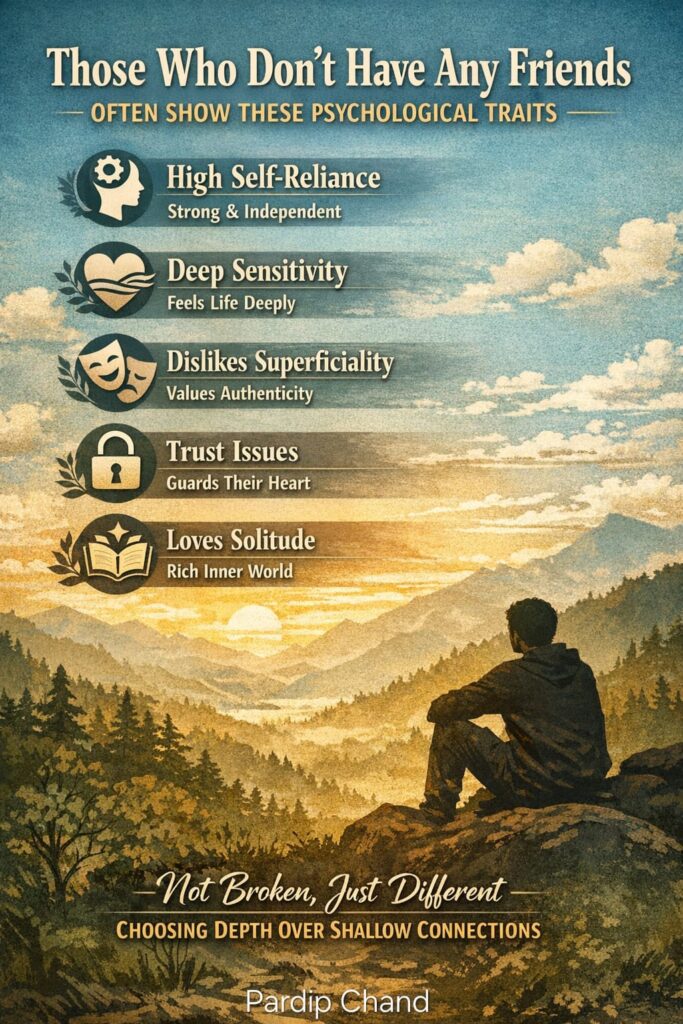
Those Who Don’t Have Any Friends Often Show These 5 Psychological Traits
Not having friends is usually misunderstood. Society tends to assume loneliness, social weakness, or emotional deficiency. Psychology, however, paints a far more complex and interesting picture. Many people without friends are not broken, antisocial, or unhappy—they are simply wired differently, shaped by experiences, values, or deep self-awareness.
Below are five psychological traits commonly found in people who don’t have friends, explained in depth. These traits are not rules or labels—but patterns that frequently emerge in research, observation, and therapeutic contexts.
1. High Self-Reliance and Emotional Independence

One of the strongest psychological traits seen in people without friends is extreme self-reliance.
What this looks like psychologically
People without friends often learn—early or gradually—that they cannot depend on others for emotional stability, validation, or problem-solving. Over time, this leads to a deep internal independence.
They:
- Process emotions alone
- Solve problems internally
- Self-soothe without external reassurance
- Rarely seek advice or comfort
This doesn’t mean they don’t want support—it means they have trained their nervous system to function without it.
Why this develops
This trait often forms due to:
- Past betrayals or disappointments
- Emotional neglect or lack of safe connections
- Repeated experiences of being misunderstood
- Growing up too fast or being forced to be “the strong one”
When people learn that relying on others leads to pain or instability, the psyche adapts by turning inward.
Psychological impact
Strengths:
- Strong coping skills
- High resilience
- Confidence in personal judgment
- Ability to survive crises alone
Challenges:
- Difficulty asking for help
- Emotional isolation
- Exhaustion from carrying everything alone
- Subtle belief that “I have to handle everything myself”
This trait often masks loneliness—not because the person is weak, but because they are too strong for too long.
2. Heightened Sensitivity and Emotional Depth

Many people without friends are emotionally deep and highly sensitive, even if they don’t appear so on the surface.
What psychology observes
Such individuals:
- Feel emotions intensely
- Think deeply about life, meaning, and existence
- Notice subtle emotional shifts in others
- Are deeply affected by words, tones, and energy
They are not “overly emotional”—they are finely tuned.
Why this leads to having no friends
Highly sensitive individuals often struggle in casual or superficial friendships. Small talk feels draining. Forced social rituals feel hollow. Emotional dishonesty feels unbearable.
They may withdraw because:
- Conversations feel shallow
- Humor feels forced or unkind
- Social dynamics feel performative
- People seem emotionally careless
Rather than constantly explaining themselves or shrinking their depth, they choose solitude.
Psychological consequences
Strengths:
- Deep empathy
- Strong moral compass
- Creativity and imagination
- Capacity for profound understanding
Challenges:
- Emotional overwhelm
- Feeling “too much” for others
- Difficulty finding like-minded people
- Increased vulnerability to loneliness
Psychologically, these individuals don’t lack friends because they are cold—but because they feel too much in a world that often feels too little.
3. Low Tolerance for Superficiality and Social Games

Another common trait is a strong aversion to fake connections.
What this trait looks like
People without friends often:
- Dislike gossip and drama
- Avoid social hierarchies and status games
- Feel uncomfortable with forced friendliness
- Refuse to maintain relationships out of obligation
They would rather have no friends than false ones.
Psychological reasoning
This trait is linked to:
- High authenticity
- Strong internal values
- Discomfort with social masks
- Preference for honesty over harmony
Many friendships require compromise—laughing when something isn’t funny, agreeing to fit in, or tolerating subtle disrespect. Some people psychologically cannot do this without feeling self-betrayal.
Impact on social life
While others maintain many acquaintances, these individuals:
- Walk away when values clash
- End relationships at the first sign of manipulation
- Avoid social circles that demand conformity
This often results in isolation—but also inner peace.
Psychological trade-off
Strengths:
- Integrity
- Self-respect
- Emotional clarity
- Strong boundaries
Challenges:
- Social isolation
- Being misunderstood as arrogant or distant
- Limited emotional outlets
Psychology suggests this is not antisocial behavior—but selective social behavior.
4. Deep Trust Issues and Fear of Emotional Vulnerability

A lack of friends is often rooted not in disinterest—but in guarded trust.
What this looks like internally
These individuals:
- Keep emotional walls high
- Share very little about themselves
- Avoid dependence
- Fear being truly seen
They may appear calm, distant, or self-contained—but internally, they are constantly evaluating safety.
How this develops
Trust issues often stem from:
- Emotional betrayal
- Childhood invalidation
- Being judged or rejected when vulnerable
- Past friendships that ended painfully
Psychologically, the mind learns:
“Connection equals risk.”
So instead of risking emotional injury again, the person unconsciously chooses isolation.
Internal conflict
Most people with this trait:
- Desire deep connection
- Miss companionship
- Feel lonely at times
But the fear of emotional pain outweighs the desire to connect.
Psychological effects
Strengths:
- Emotional self-protection
- Sharp intuition about people
- Strong personal boundaries
Challenges:
- Loneliness
- Emotional suppression
- Difficulty forming close bonds
- Chronic feeling of being misunderstood
This trait is not coldness—it is unhealed caution.
5. Comfort With Solitude and Rich Inner World

Finally, many people without friends possess a strong inner life.
What psychology observes
They often:
- Enjoy solitude
- Spend time thinking, reading, creating
- Engage in self-reflection
- Find fulfillment internally
They are not bored when alone—they are occupied inwardly.
Why this reduces friendships
People with rich inner worlds often:
- Don’t seek constant stimulation
- Aren’t motivated by social validation
- Prefer meaningful solitude over noisy company
They may find that social interaction:
- Interrupts their mental flow
- Feels draining rather than energizing
- Adds little value compared to solitude
As a result, friendships feel optional—not necessary.
Psychological strengths
- Strong imagination
- Philosophical thinking
- Self-awareness
- Emotional autonomy
Potential risks
- Emotional isolation
- Difficulty reintegrating socially
- Over-intellectualizing emotions
Psychology does not view this as unhealthy unless it turns into avoidance rather than preference.
Final Psychological Insight
Having no friends is not a psychological defect. Often, it reflects:
- Depth over breadth
- Quality over quantity
- Self-protection over exposure
- Authenticity over belonging
Many people without friends are:
- Introspective
- Emotionally intelligent
- Highly aware
- Selectively social
The real psychological danger is not being friendless—but believing that this makes you less worthy or broken.
Some people are meant to walk alone—not because they failed at connection, but because they require deeper, rarer bonds that most environments simply don’t offer.