
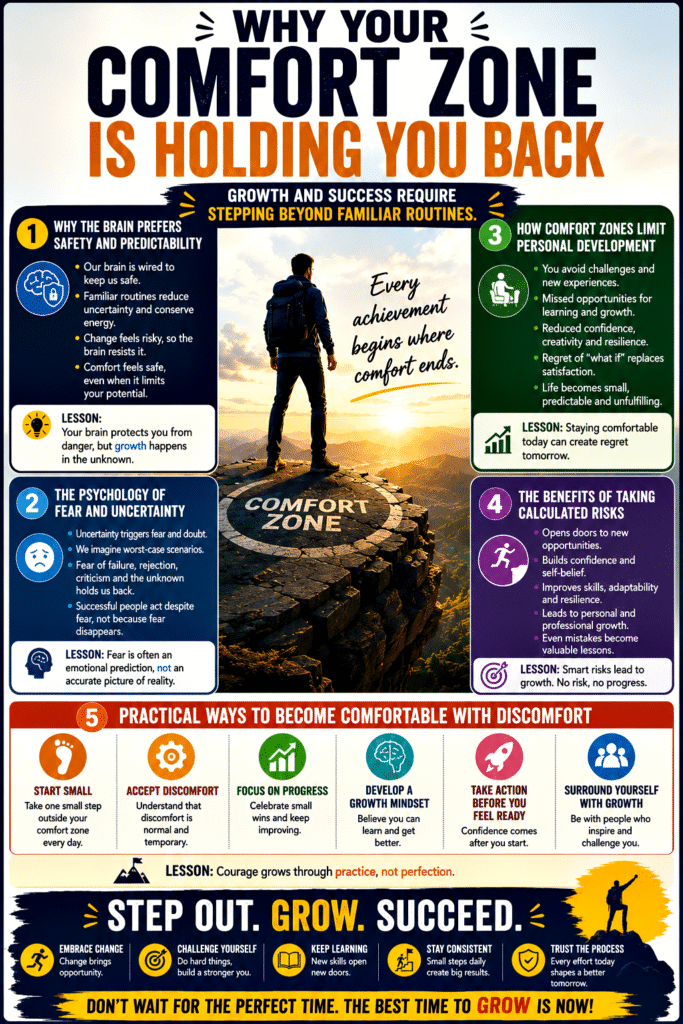
Why Stepping Outside Your Comfort Zone Leads to Success
The Psychology Behind Growth, Fear, and Success
Success rarely happens by accident. Behind every inspiring achievement lies a series of difficult choices, uncomfortable situations, and courageous actions. Yet many people spend their entire lives trapped in their comfort zones—not because they lack talent or ambition, but because their brains naturally resist change.
Your comfort zone is a place where life feels safe, predictable, and familiar. While it provides security, it can also become the biggest obstacle to personal growth. Every meaningful accomplishment—whether starting a business, changing careers, learning a new skill, or pursuing a lifelong dream—requires stepping into the unknown.
Psychology teaches us that growth begins when we challenge ourselves beyond what feels comfortable. Let’s explore why your comfort zone is holding you back and how you can overcome it.
1. Why the Brain Prefers Safety and Predictability
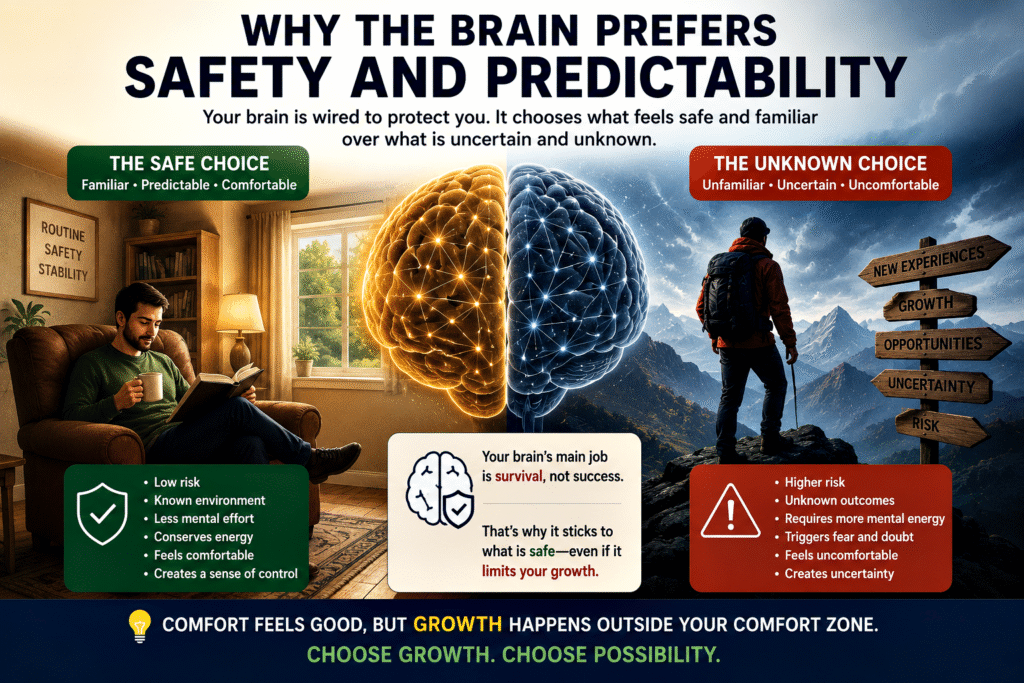
Key Point: Your brain is designed to protect you, not necessarily to help you grow.
The human brain evolved to keep us alive. Thousands of years ago, unfamiliar environments often meant danger. As a result, our brains developed a preference for routines, familiarity, and predictability.
Even today, although we no longer face wild animals every day, our brain still reacts similarly to uncertainty.
That’s why many people:
- Stay in jobs they dislike.
- Avoid difficult conversations.
- Delay starting a business.
- Hesitate to learn new skills.
- Continue unhealthy habits.
The brain interprets these familiar situations as “safe,” even when they limit happiness and success.
Whenever you consider making a major change, your brain often sends warning signals in the form of anxiety, doubt, and hesitation.
The important thing to remember is that feeling uncomfortable doesn’t necessarily mean you’re making a bad decision—it often means you’re doing something new.
Lesson:
Your brain loves familiarity, but your future depends on exploring unfamiliar opportunities.
2. The Psychology of Fear and Uncertainty
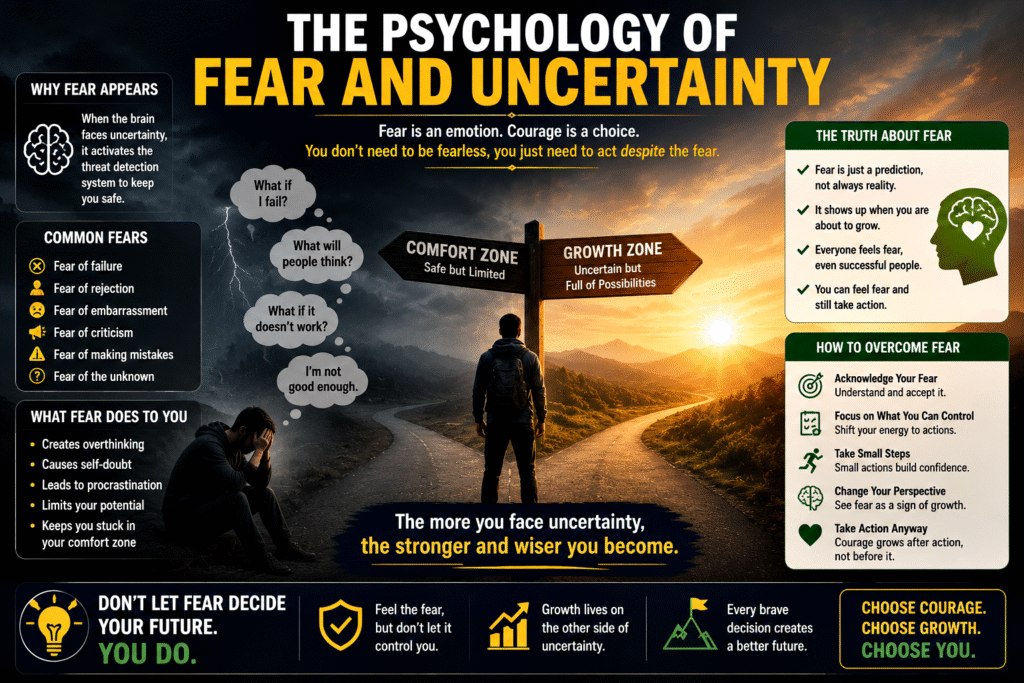
Key Point: Fear is often an emotional prediction, not an accurate picture of reality.
Fear is one of the strongest emotions influencing human behavior.
Most people assume fear is a sign to stop.
In reality, fear often appears whenever you’re about to grow.
Common fears include:
- Fear of failure
- Fear of rejection
- Fear of embarrassment
- Fear of criticism
- Fear of making mistakes
- Fear of the unknown
Psychologists explain that uncertainty activates the brain’s threat detection system.
When outcomes are unknown, the brain naturally imagines worst-case scenarios.
For example:
- “What if I fail?”
- “What if people laugh at me?”
- “What if I lose money?”
- “What if I’m not good enough?”
Ironically, these imagined outcomes rarely happen exactly as we expect.
Most successful people experience the same fears.
The difference is that they act despite their fear instead of waiting for it to disappear.
Lesson:
Fear is often a sign that you’re approaching a meaningful opportunity, not a reason to turn back.
3. How Comfort Zones Limit Personal Development
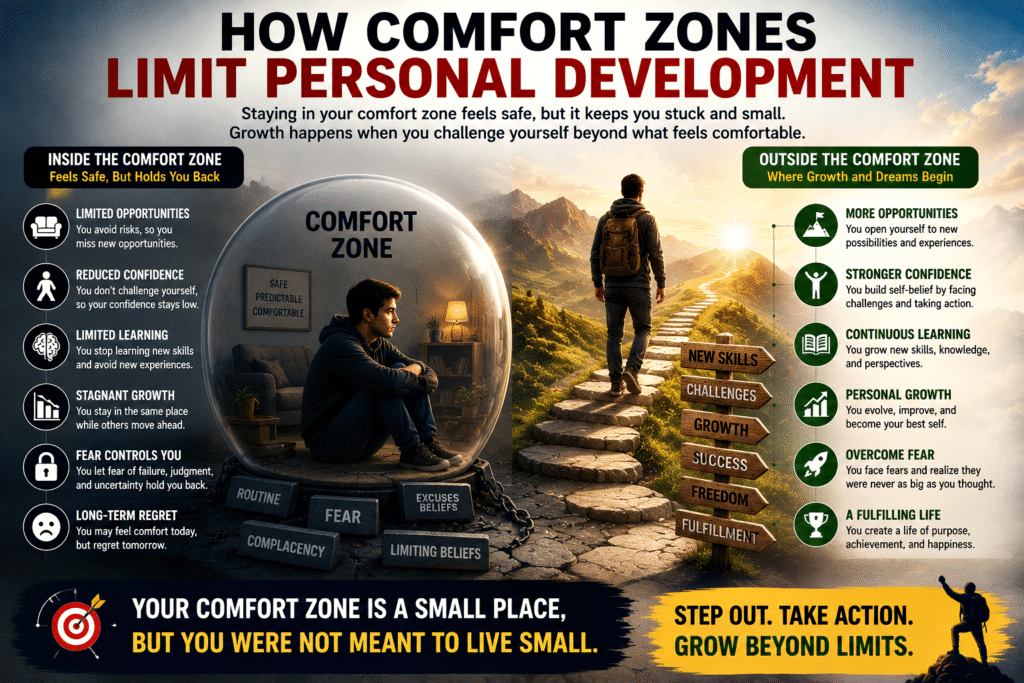
Key Point: Staying comfortable today often creates regret tomorrow.
Comfort zones feel peaceful because they require little effort.
However, remaining there for too long creates hidden costs.
When people avoid challenges, they also avoid opportunities to improve.
Over time, they experience:
- Reduced confidence
- Fewer opportunities
- Limited creativity
- Lower resilience
- Slower learning
- Missed career growth
Imagine someone who never speaks in public because they feel nervous.
Years later, they may still struggle with presentations, leadership opportunities, and career advancement—not because they lacked ability, but because they never practiced.
Personal growth follows the principle of adaptation.
The more often you challenge yourself, the more capable and confident you become.
Every uncomfortable experience expands your comfort zone a little further.
Lesson:
The comfort zone may feel safe, but it rarely leads to extraordinary achievements.
4. The Benefits of Taking Calculated Risks
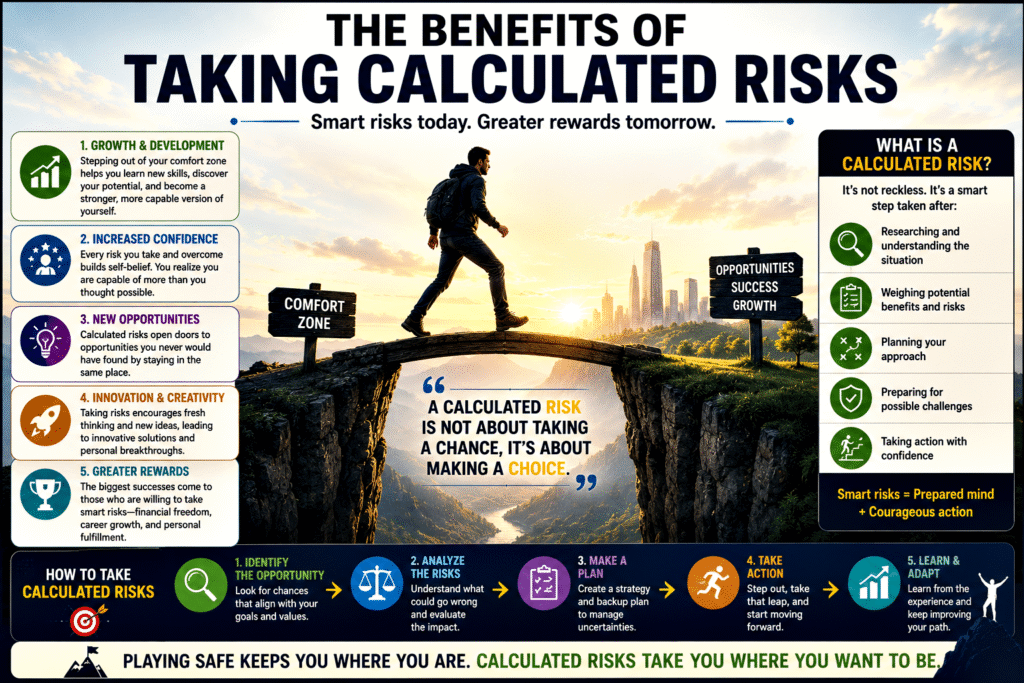
Key Point: Growth comes from smart risks, not reckless decisions.
Many people misunderstand risk.
Taking risks doesn’t mean acting without thinking.
Instead, successful people take calculated risks.
A calculated risk involves:
- Gathering information
- Preparing carefully
- Understanding possible outcomes
- Having backup plans
- Learning from mistakes
Some examples include:
- Starting a side business while keeping your current job.
- Learning a new skill before changing careers.
- Investing in education.
- Speaking up during meetings.
- Networking with new people.
- Applying for opportunities even if you don’t meet every qualification.
Each calculated risk increases experience.
Even if the outcome isn’t perfect, valuable lessons are gained.
Many of history’s greatest innovators, entrepreneurs, athletes, and artists reached success because they repeatedly chose growth over comfort.
Lesson:
Every calculated risk increases your confidence, knowledge, and opportunities for future success.
5. Practical Ways to Become Comfortable with Discomfort
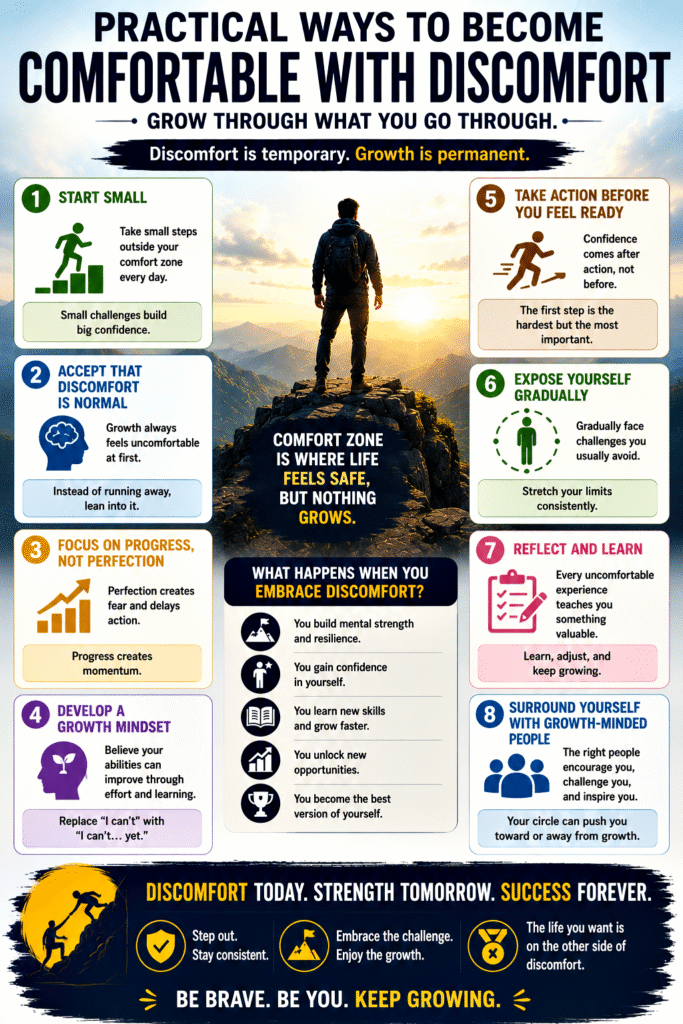
Key Point: Courage grows through practice, not perfection.
Leaving your comfort zone doesn’t require dramatic life changes overnight.
Small, consistent actions create lasting transformation.
Here are practical ways to train yourself psychologically.
Start Small
Choose one small challenge every day.
Examples include:
- Talking to someone new.
- Learning one new skill.
- Taking a different route.
- Sharing your ideas.
- Trying a new hobby.
Small wins gradually build confidence.
Accept That Discomfort Is Normal
Growth always feels uncomfortable initially.
Instead of asking,
“Why do I feel nervous?”
Ask,
“What am I learning from this experience?”
Changing your perspective reduces fear.
Focus on Progress Instead of Perfection
Perfection creates procrastination.
Improvement creates momentum.
Celebrate every step forward, no matter how small.
Develop a Growth Mindset
People with a growth mindset believe abilities improve through learning and effort.
Instead of saying,
“I can’t do this.”
Say,
“I can’t do this yet.”
One word changes your entire perspective.
Take Action Before You Feel Ready
Many people wait until they feel confident.
Confidence usually appears after taking action—not before.
The first step creates momentum.
The second step builds belief.
The third step becomes habit.
Lesson:
The more often you choose discomfort, the stronger, wiser, and more confident you become.
Conclusion
Key Point: Every achievement begins where comfort ends.
Your comfort zone is not your enemy, but staying there for too long can quietly limit your potential. The brain naturally seeks safety and predictability, which is why stepping into the unknown often feels uncomfortable. Yet that discomfort is where learning, resilience, confidence, and success are built.
Every successful person has faced moments of uncertainty. What sets them apart is not the absence of fear, but the decision to move forward despite it. By taking small, calculated risks, embracing challenges, and viewing discomfort as a sign of growth, you gradually expand your abilities and create opportunities that once seemed impossible.
Remember, your greatest achievements will rarely come from doing what feels easy—they will come from doing what helps you grow.
Final Takeaway
Your comfort zone may protect you from failure, but it also protects you from success. Step beyond it, embrace the unknown, and discover the person you are truly capable of becoming.