
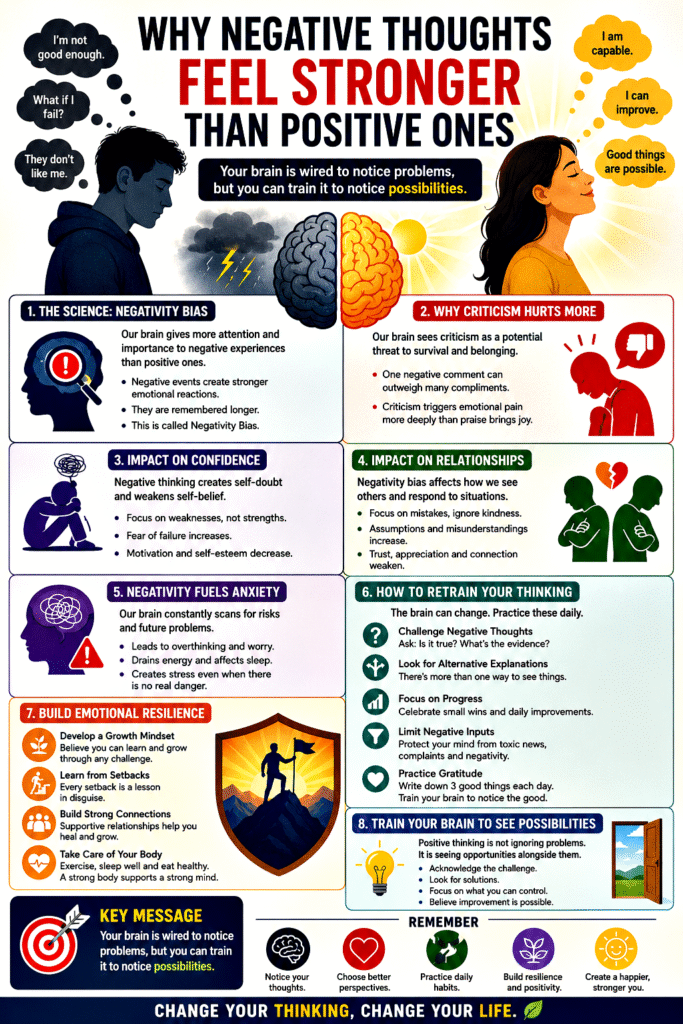
The Hidden Reason Your Brain Focuses on the Negative
Introduction
Have you ever noticed that one negative comment can stay in your mind for days, while ten compliments are quickly forgotten? A small mistake can ruin your mood, even when many things went right. This happens because the human brain naturally pays more attention to negative experiences than positive ones.
Psychologists call this tendency negativity bias. It is a built-in survival mechanism that helped our ancestors stay alive in dangerous environments. While this bias was useful thousands of years ago, it can create unnecessary stress, anxiety, and self-doubt in modern life.
The good news is that although your brain is wired to notice problems, you can train it to notice opportunities, strengths, and positive experiences as well.
1. What Is Negativity Bias?
Key Point:
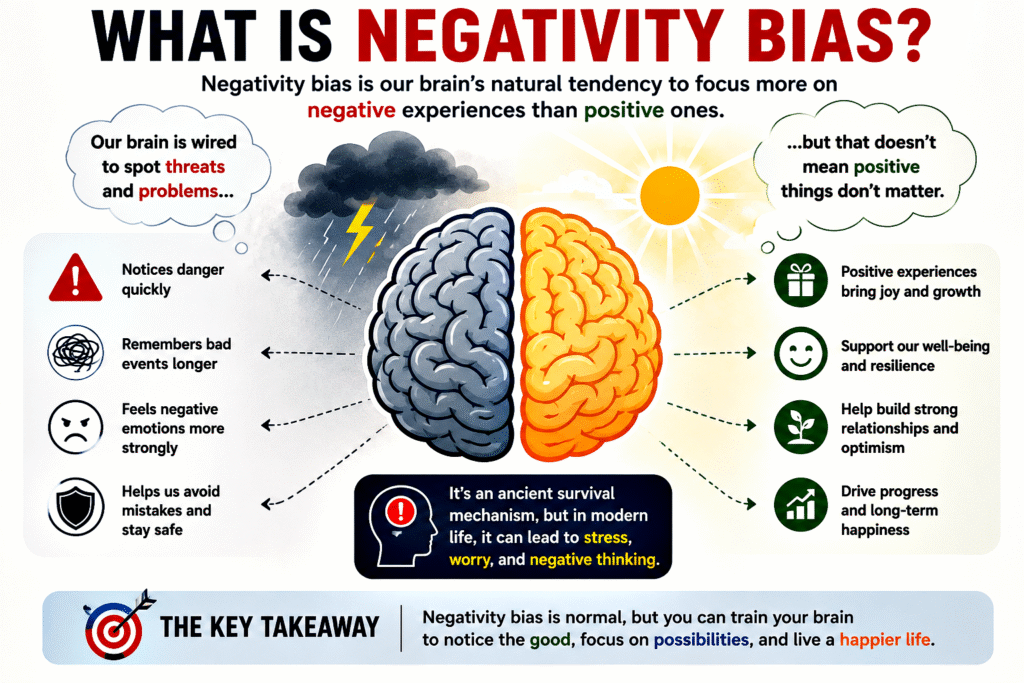
The brain naturally gives more attention and importance to negative experiences than positive ones.
Negativity bias is the tendency to focus more on threats, mistakes, failures, criticism, and unpleasant events than on positive experiences.
For example:
- One insult often hurts more than several compliments help.
- A single failure may overshadow many successes.
- Bad news usually attracts more attention than good news.
Research shows that negative events create stronger psychological reactions and are remembered longer than positive events of equal intensity.
Why It Matters
Because of negativity bias:
- We remember embarrassing moments more vividly.
- We worry more about possible failures.
- We focus on what is wrong rather than what is working.
This tendency influences our thoughts, emotions, decisions, and relationships every day.
2. The Evolutionary Reason Behind Negativity Bias
Key Point:
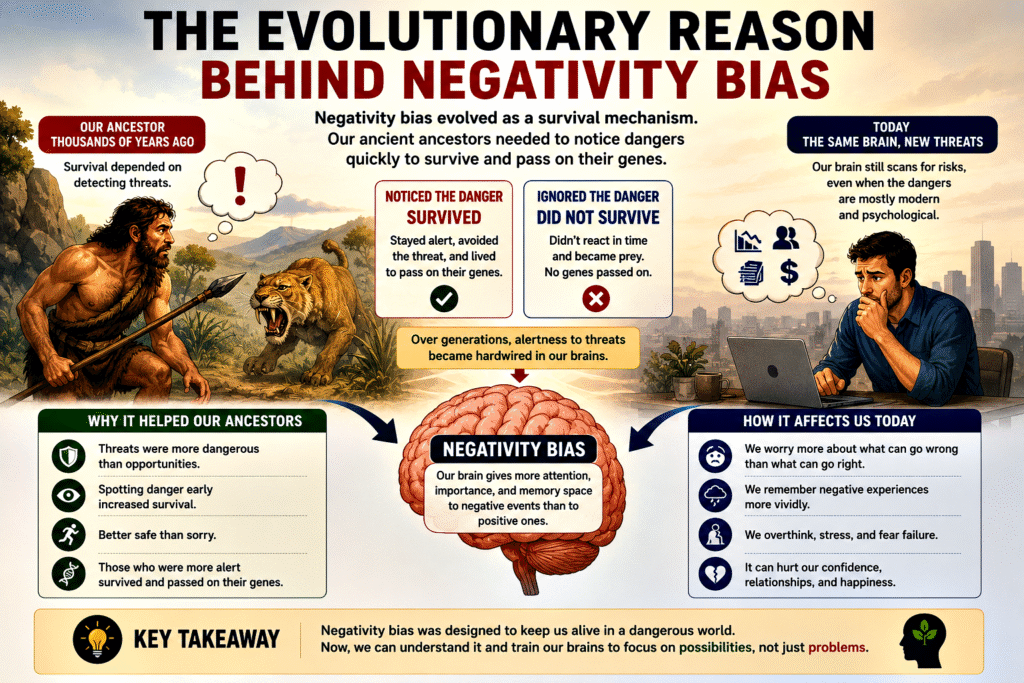
Negativity bias evolved as a survival tool.
Thousands of years ago, human survival depended on recognizing danger quickly.
Imagine two prehistoric humans:
- One notices a potential predator hiding in the bushes.
- The other ignores the threat and focuses on the beautiful scenery.
The cautious person is more likely to survive and pass on their genes.
As a result, the human brain evolved to prioritize:
- Threats
- Risks
- Losses
- Pain
- Social rejection
Our ancestors benefited from being alert to danger. The problem is that today’s threats are often psychological rather than physical.
Instead of worrying about predators, we worry about:
- Job performance
- Social approval
- Financial security
- Personal failures
The same survival system remains active even when our lives are relatively safe.
3. Why Criticism Hurts More Than Praise Helps
Key Point:
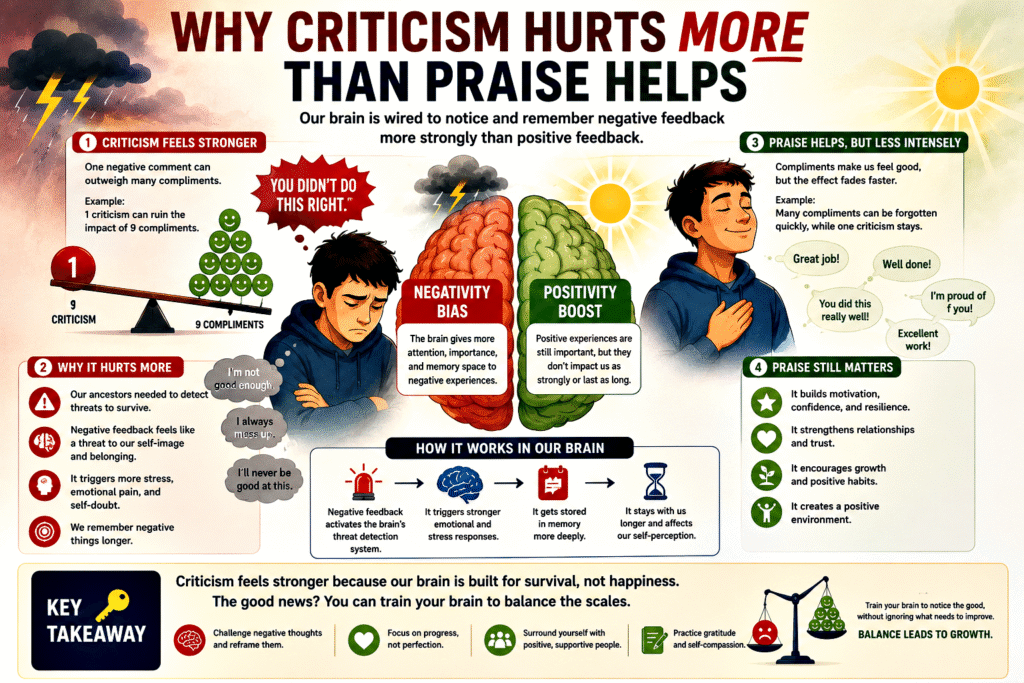
Negative feedback carries more emotional weight than positive feedback.
Imagine receiving:
- Nine compliments
- One criticism
What will you think about most?
For many people, it is the criticism.
This happens because the brain treats criticism as important information related to social acceptance and survival.
Effects of Criticism
Negative feedback can:
- Trigger emotional pain
- Lower confidence
- Create self-doubt
- Increase stress levels
Meanwhile, praise often feels good only temporarily.
This does not mean positive feedback is unimportant. It simply means the brain processes negative information more deeply.
Practical Example
A student receives:
- Excellent grades in five subjects
- A poor grade in one subject
Instead of celebrating success, they may obsess over the one disappointing result.
This is negativity bias in action.
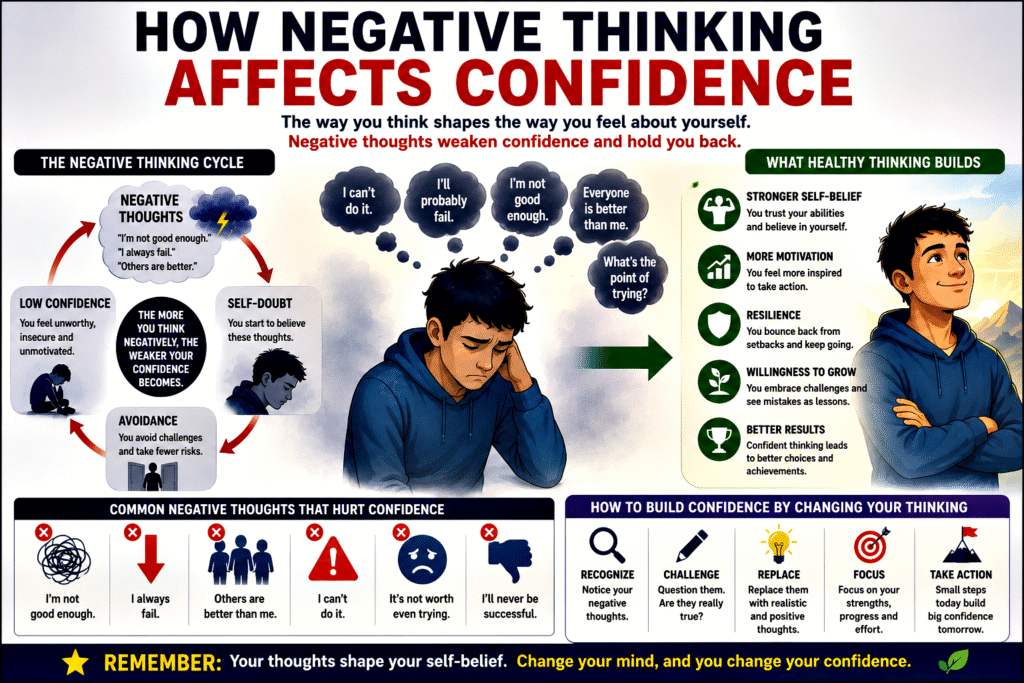
4. How Negative Thinking Affects Confidence
Key Point:
Persistent negative thoughts weaken self-belief.
When negative thoughts repeat frequently, they start shaping how we see ourselves.
Common negative thoughts include:
- “I am not good enough.”
- “I always fail.”
- “Others are better than me.”
- “I will never succeed.”
Over time, these thoughts become mental habits.
Consequences
Negative thinking can lead to:
- Low self-esteem
- Fear of failure
- Reduced motivation
- Avoidance of challenges
People begin focusing on weaknesses while ignoring strengths and achievements.
The result is a cycle where self-doubt creates hesitation, and hesitation limits growth.
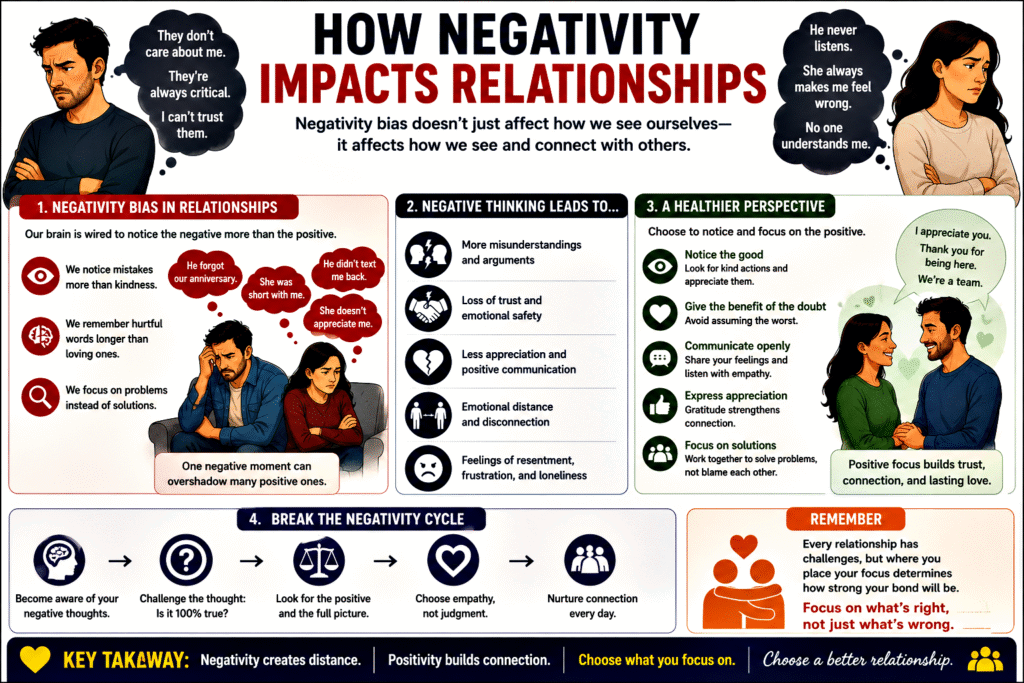
5. How Negativity Impacts Relationships
Key Point:
Negative thinking can damage communication and trust.
Negativity bias does not only affect how we see ourselves; it also affects how we see others.
Examples include:
- Assuming bad intentions.
- Focusing on a partner’s mistakes.
- Remembering conflicts more than positive moments.
- Expecting rejection or criticism.
Relationship Problems Caused by Negativity
When negative thoughts dominate:
- Arguments become more frequent.
- Trust becomes weaker.
- Appreciation decreases.
- Emotional distance increases.
A relationship may contain many positive experiences, but if people focus only on the negative ones, dissatisfaction grows.
Healthy relationships require consciously noticing kindness, support, and positive interactions.
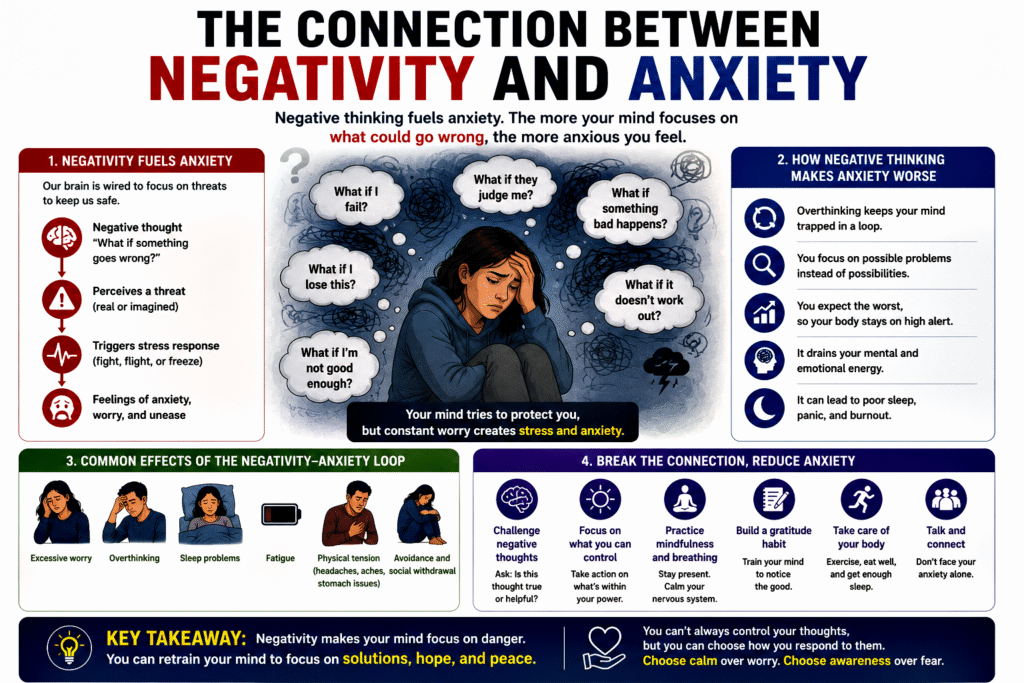
6. The Connection Between Negativity and Anxiety
Key Point:
Negative thinking fuels worry about future problems.
Anxiety often involves imagining potential dangers.
Examples include:
- “What if I fail?”
- “What if something goes wrong?”
- “What if people judge me?”
The brain attempts to prepare for threats by constantly scanning for risks.
Unfortunately, this process often creates unnecessary stress.
Common Effects
Excessive negative thinking may cause:
- Overthinking
- Chronic worry
- Difficulty sleeping
- Emotional exhaustion
The mind becomes trapped in a cycle of anticipating problems that may never happen.
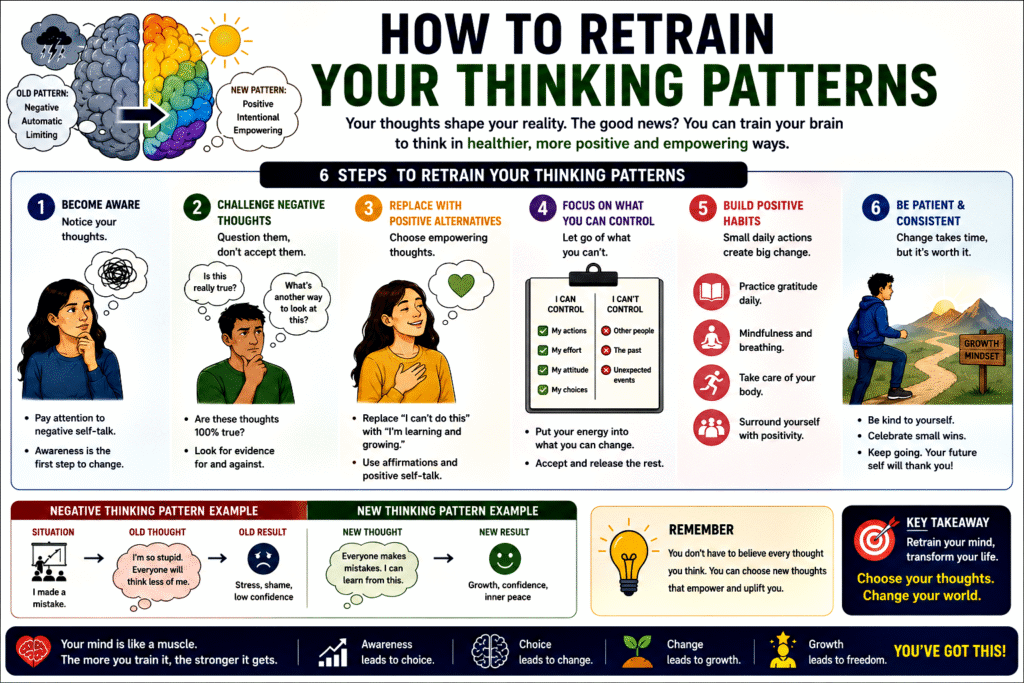
7. How to Retrain Your Thinking Patterns
Key Point:
The brain can be trained to become more balanced and positive.
Thanks to neuroplasticity, the brain can form new thinking habits.
Practical Strategies
A. Challenge Negative Thoughts
Ask yourself:
- Is this thought really true?
- What evidence supports it?
- What evidence contradicts it?
This helps separate facts from assumptions.
B. Look for Alternative Explanations
Instead of thinking:
- “I failed because I am incompetent.”
Try:
- “I made a mistake and can learn from it.”
Balanced thinking is more accurate and helpful.
C. Focus on Progress
Rather than concentrating only on what is missing:
- Notice improvements.
- Celebrate small wins.
- Recognize effort.
Progress builds confidence over time.
D. Limit Negative Inputs
Constant exposure to negativity can reinforce pessimistic thinking.
Consider reducing:
- Excessive negative news
- Toxic social media content
- Constant complaining environments
Protecting your mental environment matters.
8. Practice Gratitude Daily

Key Point:
Gratitude helps counterbalance the brain’s focus on problems.
The brain naturally scans for what is wrong.
Gratitude encourages it to notice what is right.
Simple gratitude practices include:
- Writing down three good things each day.
- Appreciating supportive people.
- Reflecting on personal achievements.
- Recognizing opportunities and blessings.
Research consistently shows that gratitude improves:
- Happiness
- Optimism
- Emotional well-being
The more often you practice gratitude, the easier it becomes to notice positive experiences.
9. Build Emotional Resilience
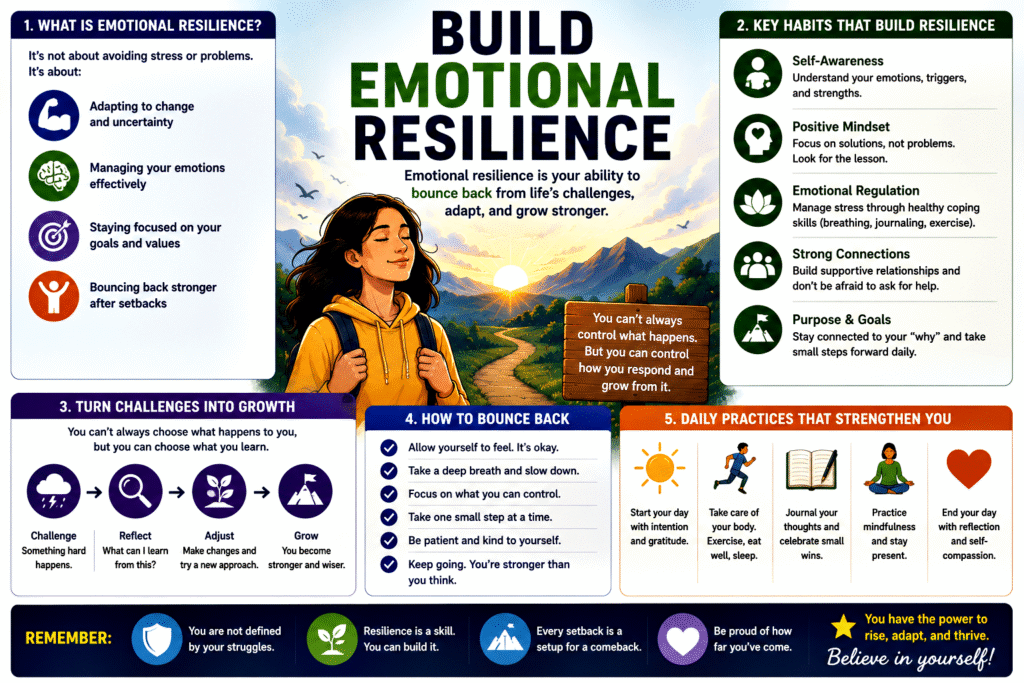
Key Point:
Resilience helps you recover from setbacks more effectively.
Life will always contain challenges.
Resilience is not about avoiding difficulties. It is about responding to them constructively.
Ways to Strengthen Resilience
Develop a Growth Mindset
Believe that skills and abilities can improve through effort and learning.
Learn from Setbacks
Ask:
- What can this experience teach me?
- How can I improve next time?
Maintain Supportive Relationships
Strong social connections provide encouragement during difficult times.
Take Care of Physical Health
Regular exercise, proper sleep, and healthy nutrition improve emotional stability.
A resilient mind can acknowledge negative experiences without being controlled by them.
10. Train Your Brain to Notice Possibilities
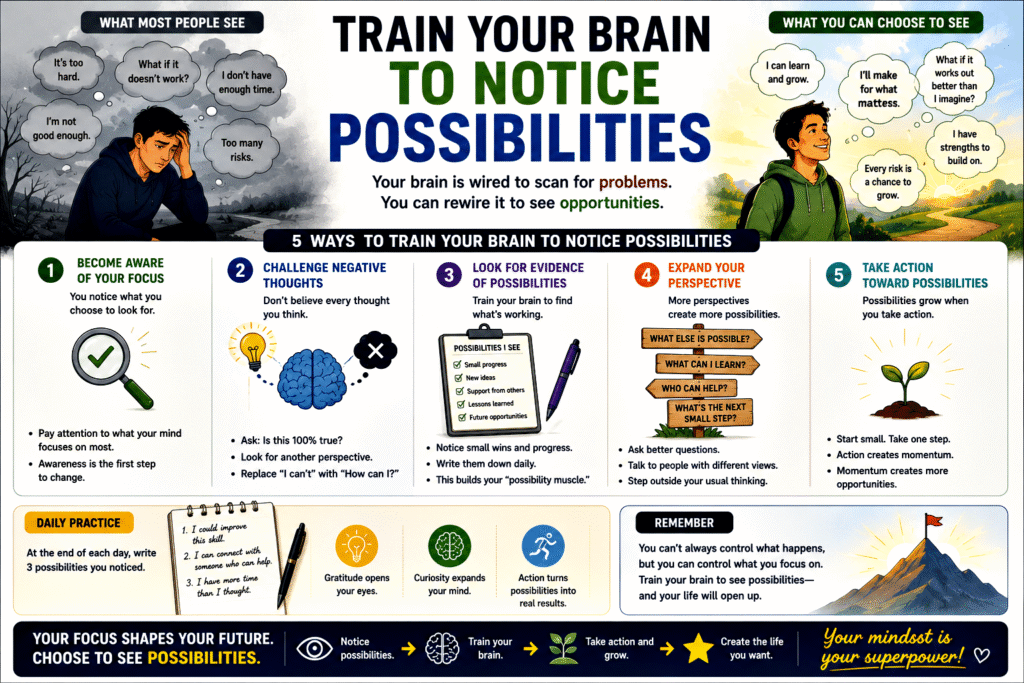
Key Point:
Positive thinking is not ignoring problems—it is seeing opportunities alongside them.
Many people misunderstand positivity.
Healthy positivity does not mean pretending everything is perfect.
Instead, it means:
- Recognizing challenges.
- Looking for solutions.
- Believing improvement is possible.
When facing obstacles, ask:
- What can I learn from this?
- What opportunities exist here?
- What is still within my control?
These questions shift attention from helplessness to action.
Conclusion
Negative thoughts feel stronger than positive ones because the human brain evolved to prioritize threats and dangers. This negativity bias once helped our ancestors survive, but in modern life it can contribute to anxiety, low confidence, and strained relationships.
Fortunately, our brains are not fixed. Through conscious effort, gratitude, balanced thinking, and emotional resilience, we can retrain our minds to notice not only problems but also possibilities.
Key Takeaways
- The brain naturally focuses on negative experiences.
- Criticism affects us more strongly than praise.
- Negative thinking can damage confidence and relationships.
- Gratitude and balanced thinking help reduce negativity bias.
- Emotional resilience allows faster recovery from setbacks.
- Positive thinking is about seeing opportunities, not ignoring reality.
Remember: Your brain is wired to notice problems, but with practice, you can train it to notice strengths, opportunities, growth, and hope as well.