How social media is destroying your attention span
The world around us is constantly stimulating. Our phones buzz with notifications every few minutes, our social media feeds update incessantly, and short videos provide instant entertainment. Information is now more easily accessible than ever, thanks to modern technology, but it has also brought about a serious issue: people are losing their ability to focus. Today, many people struggle with:
- Pay intense attention
- Perform at your best without being interrupted
- Read for long periods
- Be patient when things move slowly.
This is not just a result of poor discipline. It has a strong connection to how the brain responds to immediate rewards and dopamine. The brain develops a need for constant stimulation over time as a result of modern distractions’ ability to draw attention. As a result, focus becomes harder, patience decreases, and deep thinking feels mentally exhausting.
The truth is:
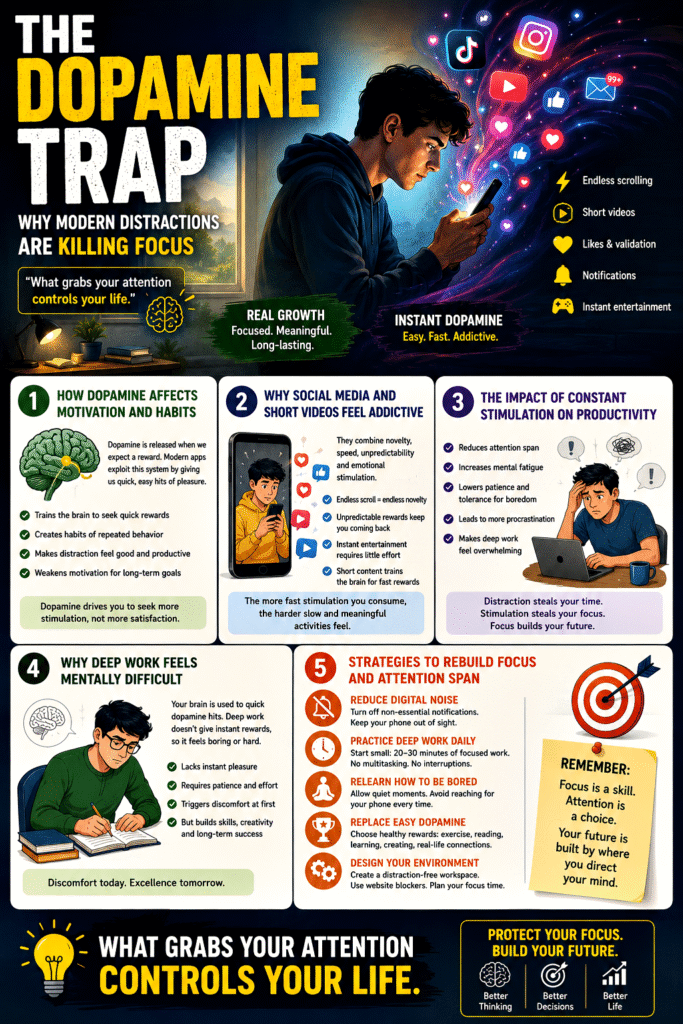
What grabs your attention controls your life.
This article explores the psychology behind dopamine, why social media feels addictive, how constant stimulation damages productivity, and practical ways to rebuild focus in a distracted world.
1. How Dopamine Affects Motivation and Habits
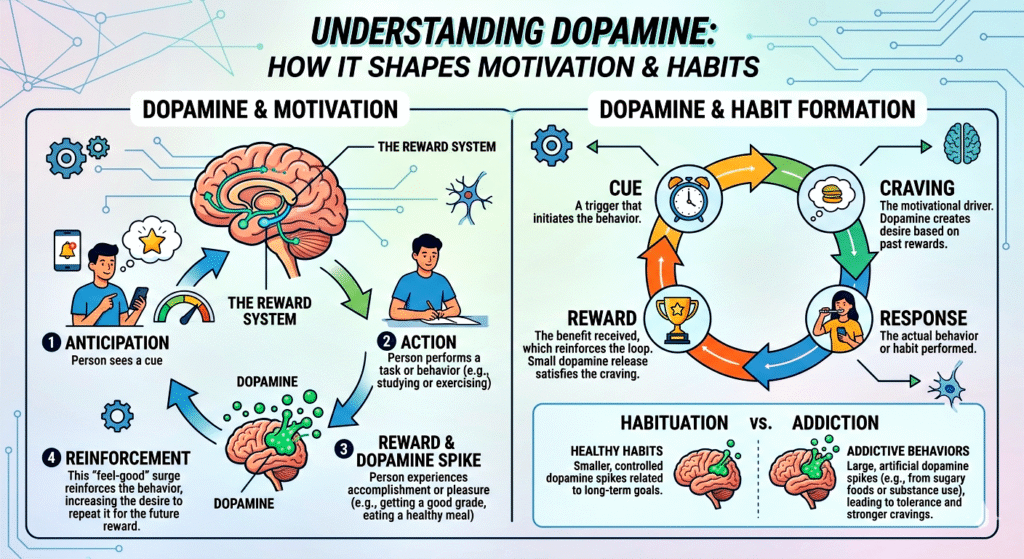
Dopamine is often misunderstood as the “pleasure chemical,” but it is more accurately connected to motivation, anticipation, and reward-seeking behavior.
Dopamine is released when the brain expects something rewarding. This includes:
- Receiving notifications
- Watching entertaining videos
- Getting likes on social media
- Winning games
- Eating junk food
The brain quickly learns to repeat behaviors that produce dopamine.
This system was originally designed for survival. Thousands of years ago, dopamine motivated humans to seek food, safety, and opportunities. Today, technology exploits the same reward system.
Apps and platforms are intentionally designed to keep people engaged by offering:
- Endless scrolling
- Random rewards
- Constant novelty
- Instant entertainment
Every swipe, click, or notification creates small dopamine spikes that encourage repeated behavior.
Key Point:
Dopamine drives people to seek stimulation repeatedly, which is why distractions become habits so quickly.
The problem is not dopamine itself—it is the constant overconsumption of easy rewards.
2. Why Social Media and Short Videos Feel Addictive
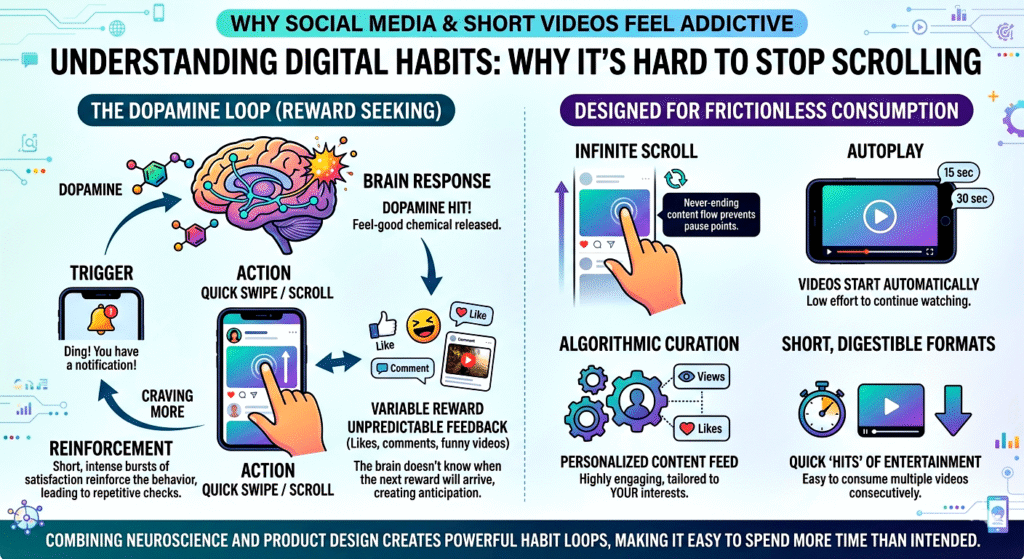
Social media and short-form content are especially powerful because they combine:
- Novelty
- Speed
- Unpredictability
- Emotional stimulation
The brain loves novelty. Every new video, image, or notification feels like a potential reward. This unpredictability keeps people checking their phones repeatedly.
This is similar to how slot machines work:
- Sometimes the reward is exciting
- Sometimes it is boring
- But the uncertainty keeps people coming back
Short videos are particularly addictive because they provide:
- Instant entertainment
- Fast emotional stimulation
- Constant variety
Unlike books or deep conversations, short content requires very little mental effort.
Over time, the brain becomes accustomed to:
- Fast rewards
- Constant stimulation
- Short attention spans
As a result, slower activities begin to feel boring.
For example:
- Reading a book feels difficult
- Long study sessions feel exhausting
- Quiet moments feel uncomfortable
Key Point:
The more the brain consumes fast stimulation, the harder it becomes to enjoy slow, meaningful activities.
3. The Impact of Constant Stimulation on Productivity
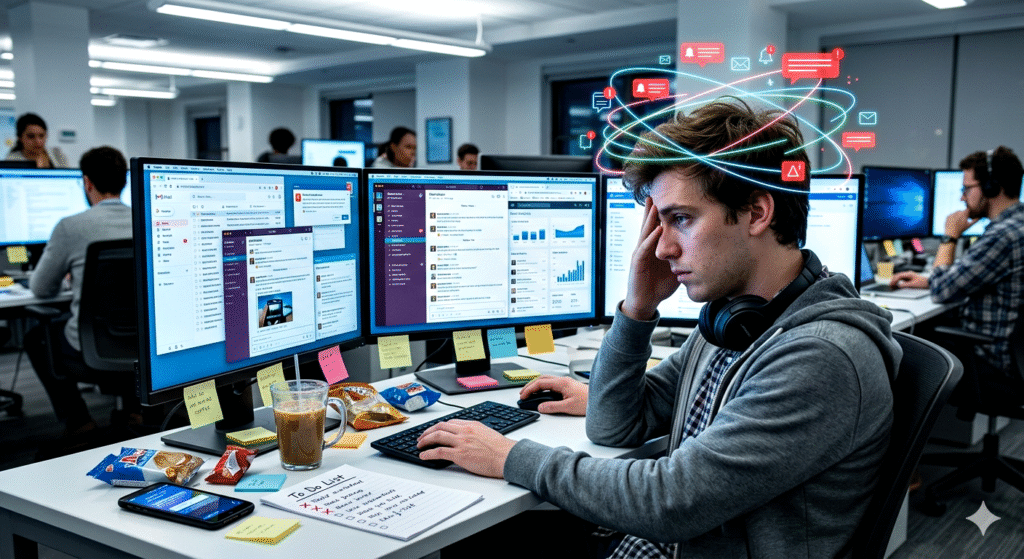
Constant digital stimulation damages productivity in several ways.
i. Reduced Attention Span
Frequent distractions train the brain to switch focus constantly.
When people repeatedly:
- Check notifications
- Open multiple apps
- Scroll during work
Their brains adapt to fragmented attention.
As a result, concentrating for long periods becomes difficult.
ii. Mental Fatigue
Every distraction consumes mental energy.
Even brief interruptions force the brain to:
- Refocus
- Reorganise thoughts
- Restart concentration
This increases cognitive exhaustion.
iii. Lower Patience
Instant rewards reduce tolerance for slow progress.
People become less willing to:
- Learn difficult skills
- Work through challenges
- Stay consistent with long-term goals
This weakens persistence and discipline.
iv. Increased Procrastination
Modern distractions offer easy emotional escape.
Instead of doing difficult work, people choose activities that provide immediate dopamine:
- Social media
- Videos
- Games
- Endless scrolling
Key Point:
Constant stimulation weakens focus, patience, and the ability to do meaningful work consistently.
4. Why Deep Work Feels Mentally Difficult
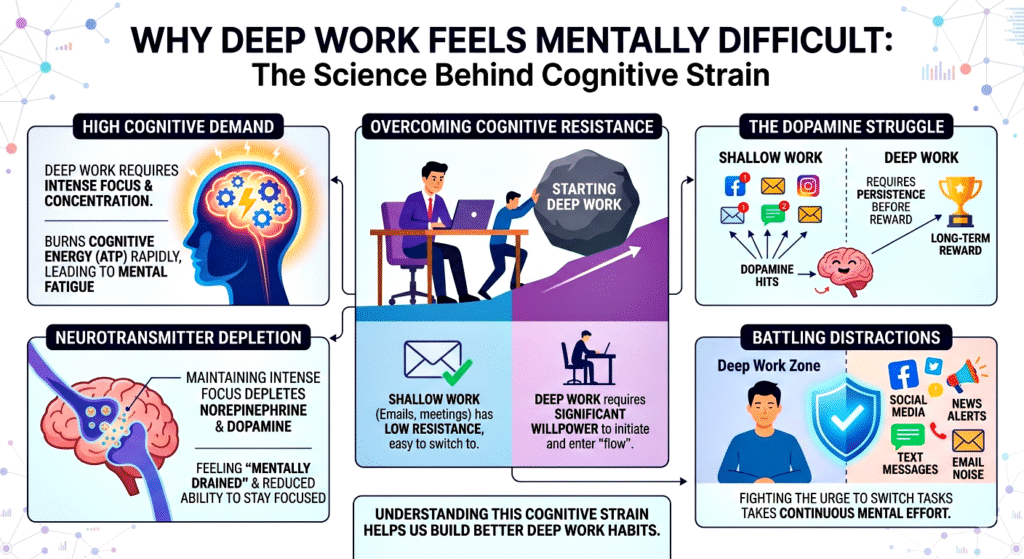
Deep work refers to focused, uninterrupted concentration on meaningful tasks.
Examples include:
- Studying
- Writing
- Solving complex problems
- Creative thinking
- Learning difficult skills
However, deep work feels difficult because the modern brain is overstimulated.
When someone is used to constant digital stimulation, silence and focus can feel uncomfortable.
Why?
Because deep work lacks:
- Instant rewards
- Fast entertainment
- Continuous novelty
At first, focused work may feel:
- Boring
- Frustrating
- Mentally exhausting
This is not because the person is incapable—it is because the brain has adapted to quick stimulation.
The brain now expects frequent dopamine hits.
Deep work requires the opposite:
- Patience
- Delayed gratification
- Sustained attention
Key Point:
Deep focus feels difficult because modern distractions train the brain to avoid boredom and seek constant stimulation.
Ironically, boredom itself is important. It allows:
- Creativity
- Reflection
- Problem-solving
- Mental recovery
Without quiet moments, the mind rarely gets the chance to think deeply.
5. Strategies to Rebuild Focus and Attention Span
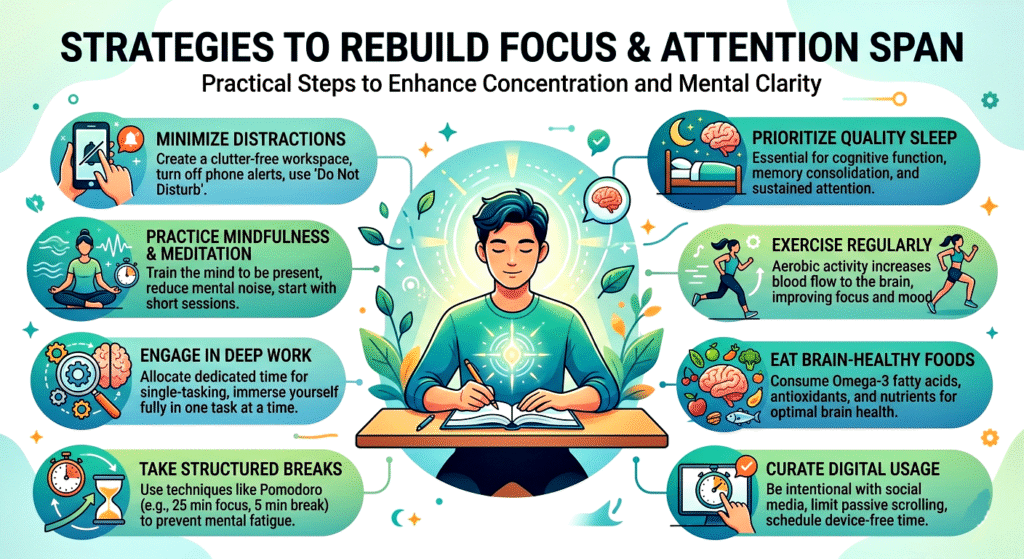
Although modern distractions are powerful, focus can be rebuilt with intentional habits and environmental changes.
i. Reduce Digital Noise
Turn off unnecessary notifications.
Every notification competes for attention and interrupts mental focus.
Practical steps:
- Silence non-essential apps
- Keep the phone away during work
- Limit social media usage
Key Point:
What constantly interrupts your attention eventually controls your behavior.
ii. Practice Deep Work in Small Sessions
Focus is like a muscle—it strengthens with practice.
Start with:
- 20–30 minutes of uninterrupted work
- Gradually increase focus time
Avoid multitasking during these sessions.
Key Point:
The brain becomes stronger at focusing when distractions are reduced consistently.
iii. Relearn How to Be Bored
Most people instantly escape boredom by reaching for their phones.
Instead:
- Sit quietly sometimes
- Walk without music
- Avoid constant stimulation
This retrains the brain to tolerate slower experiences.
Key Point:
Boredom is not the enemy—it is often the beginning of creativity and clarity.
iv. Replace Easy Dopamine With Meaningful Rewards
Not all dopamine is harmful.
Healthy dopamine can come from:
- Exercise
- Learning
- Completing goals
- Real-life relationships
- Creative work
These activities create longer-lasting satisfaction.
Key Point:
Temporary stimulation feels good quickly, but meaningful progress feels good deeply.
v. Design Your Environment for Focus
Environment strongly influences behavior.
Helpful changes include:
- Creating a distraction-free workspace
- Keeping the phone out of sight
- Using website blockers during work
- Scheduling focused time intentionally
Key Point:
Discipline becomes easier when your environment supports concentration.
Conclusion: Attention Is Your Most Valuable Resource
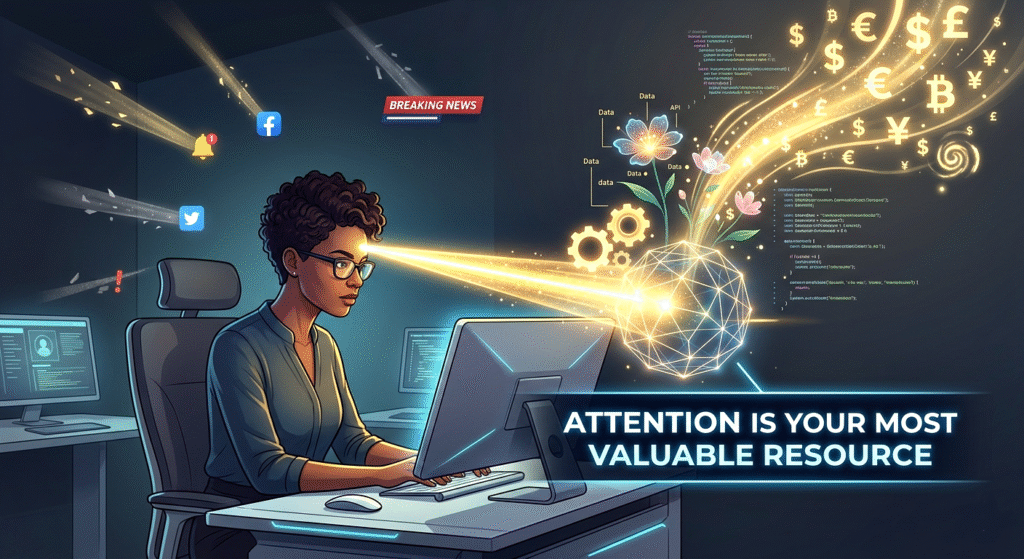
In today’s world, attention has become one of the most valuable and manipulated resources.
Technology constantly competes for focus because attention drives:
- Habits
- Decisions
- Productivity
- Emotions
- Lifestyle choices
The more distracted people become, the harder it is to think deeply, create meaningfully, and stay connected to long-term goals.
The dopamine trap is dangerous because it slowly rewires the brain to prefer quick stimulation over meaningful effort.
But focus can be rebuilt.
By reducing distractions, practicing deep work, and learning to tolerate boredom again, people can regain control over their attention and their lives.
Because in the end:
What grabs your attention controls your future.