
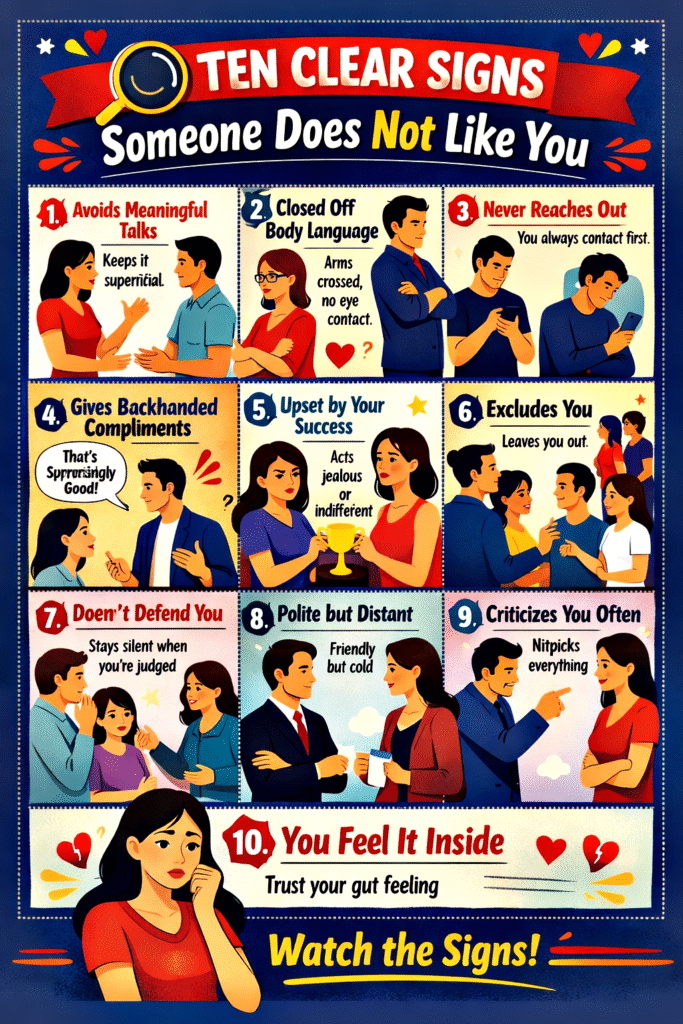
10 Hidden Behaviours That Reveal Someone Doesn’t Like You
“You know someone quietly dislikes you if they display these ten behaviours.”
This doesn’t always mean hatred or open conflict—often it’s subtle, indirect, and expressed through small, consistent patterns.
1. They Avoid Meaningful Conversations

One of the clearest signs of quiet dislike is emotional distance. A person who doesn’t like you may still talk to you, but the conversations often feel shallow, forced, or strictly necessary. They won’t engage in deeper discussions, share personal thoughts, or show genuine curiosity about your life.
When you try to connect, their responses may be short or generic, like “okay,” “nice,” or “that’s good,” without any follow-up questions. This indicates a lack of emotional investment. People naturally engage more with those they like; when that engagement is missing, it often signals disinterest or discomfort.
Over time, you may notice that they open up freely with others but remain guarded around you. This selective communication is rarely accidental—it reflects their internal preference to keep distance.
2. Their Body Language Feels Closed or Defensive

Human beings communicate a lot without words. Someone who quietly dislikes you may not say anything negative, but their body language will often reveal their feelings.
They might:
- Avoid eye contact
- Turn their body away from you
- Cross their arms frequently
- Maintain physical distance
Even subtle cues like checking their phone while you’re speaking or leaning away during conversations can signal discomfort or disinterest.
Body language is often subconscious, meaning it reflects genuine feelings more honestly than words. If someone consistently displays closed-off behaviour only around you, it’s worth paying attention.
3. They Rarely Initiate Contact

Relationships—whether friendships, work relationships, or acquaintances—require mutual effort. If someone never initiates conversations, messages, or plans with you, it may indicate a lack of interest.
You might notice that:
- You’re always the one texting first
- They rarely suggest meeting up
- Conversations fade unless you keep them going
While people can be busy, a consistent pattern of non-initiation suggests that staying connected with you is not a priority for them.
4. They Give Backhanded Compliments

A backhanded compliment is a subtle way of expressing negativity while appearing polite. For example:
- “You did surprisingly well.”
- “That outfit actually looks good on you.”
These comments may sound positive on the surface, but they carry an underlying tone of criticism or condescension.
People who quietly dislike you may use such remarks to express their feelings indirectly. It allows them to maintain social politeness while still undermining you.
5. They Seem Unhappy About Your Success

A person who genuinely likes you will celebrate your achievements. In contrast, someone who dislikes you may react differently.
Signs include:
- Minimal or forced congratulations
- Changing the topic quickly
- Downplaying your achievements
- Showing more enthusiasm for others’ success
This reaction often stems from comparison, insecurity, or resentment. Instead of feeling happy for you, they may feel threatened or indifferent.
6. They Subtly Exclude You

Exclusion is one of the most telling signs of quiet dislike. It doesn’t have to be obvious—often it’s subtle and easy to overlook.
For example:
- Not inviting you to group activities
- Leaving you out of conversations
- Sharing information with others but not you
Sometimes they may justify it as an oversight, but if it happens repeatedly, it likely reflects intentional distancing.
Social inclusion is a natural behaviour among people who enjoy each other’s company. Being consistently left out suggests the opposite.
7. They Don’t Defend You in Your Absence

When someone respects or likes you, they are more likely to stand up for you—even when you’re not present.
A person who quietly dislikes you may:
- Stay silent when others criticize you
- Agree with negative remarks about you
- Avoid correcting misinformation
This doesn’t always mean they actively speak against you, but their lack of support speaks volumes. Silence in such situations can indicate indifference or hidden agreement.
8. They Appear Polite but Emotionally Distant

Not all dislike is expressed through rudeness. In many cases, it appears as excessive politeness combined with emotional coldness.
They may:
- Use formal or distant language
- Avoid humor or warmth with you
- Keep interactions strictly transactional
This creates a sense of “surface-level friendliness” that lacks genuine connection. It often feels like they’re being nice because they have to, not because they want to.
9. They Frequently Criticise or Correct You

Constructive feedback is normal in any relationship, but constant criticism—especially when unnecessary—can signal underlying dislike.
They might:
- Point out small mistakes
- Correct you in public
- Focus more on your flaws than your strengths
The tone matters here. If their feedback feels more like judgment than support, it’s likely driven by negative feelings rather than genuine concern.
10. Your Intuition Feels Something Is Off

Sometimes, the strongest indicator isn’t a specific behavior—it’s your overall feeling.
You may notice:
- A sense of tension around them
- Feeling uncomfortable or judged
- A lack of warmth in interactions
Human intuition is powerful. It picks up on patterns, tone, and subtle cues that are difficult to articulate logically. While it shouldn’t be the only factor you rely on, it often aligns with observable behaviours.
Final Thoughts
It’s important to remember that these signs are not absolute proof of dislike. People behave differently for many reasons—stress, introversion, insecurity, or personal struggles can all influence behaviour.
However, when multiple signs appear consistently over time, they form a pattern that’s hard to ignore.
Instead of reacting emotionally, the best approach is:
- Stay calm and observant
- Avoid jumping to conclusions too quickly
- Maintain your self-respect
- Focus on relationships that are mutual and supportive
Not everyone will like you—and that’s perfectly normal. What matters most is how you respond. Choosing maturity, awareness, and emotional balance will always work in your favour.