
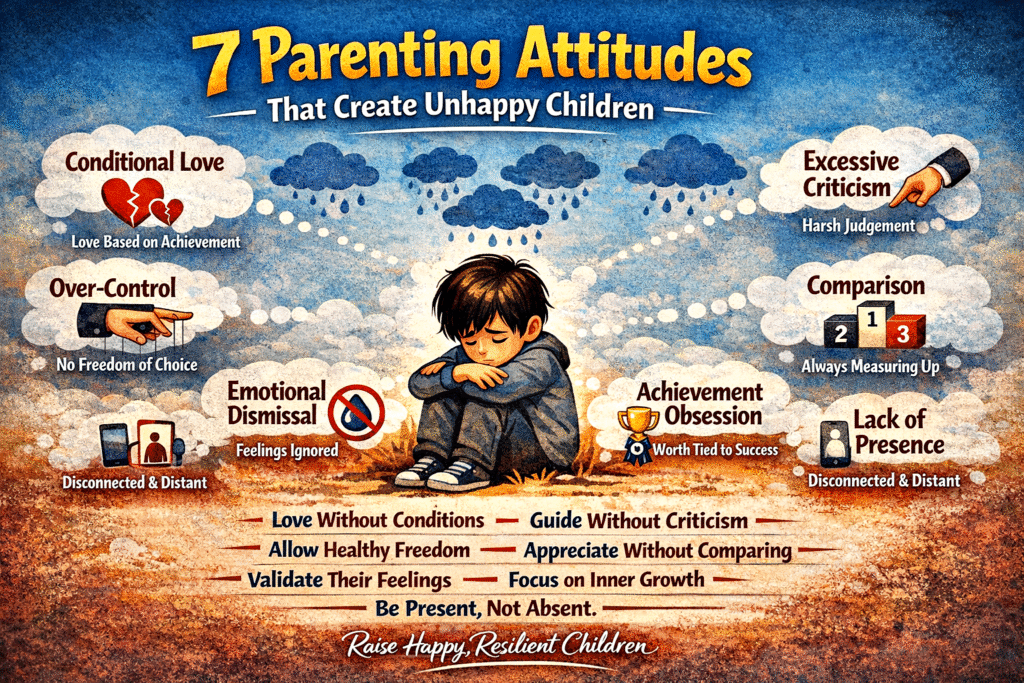
7 Parenting Attitudes That Secretly Make Children Unhappy
Here are seven parenting attitudes that often create unhappy children, explained in a clear, practical, and deeply insightful way. These are not about blaming parents — but about understanding subtle patterns that silently shape a child’s emotional world.
Seven Parenting Attitudes That Create Unhappy Children
A child’s happiness is not built through toys, privileges, or achievements — it is built through emotional safety, acceptance, and connection.
Sometimes, without realising it, parents adopt attitudes that damage a child’s inner confidence and emotional well-being. These attitudes may come from love, fear, social pressure, or even the parents’ own upbringing.
Let us explore the seven most common ones.
1. Conditional Love Instead of Unconditional Acceptance
When children feel loved only when they perform well, behave perfectly, or meet expectations, they begin to associate love with achievement.
Examples include:
- “I’m proud of you only when you score well.”
- Extra affection when the child wins something.
- Withdrawal of warmth when the child fails.
This creates a dangerous belief in the child:
👉 “I am worthy only when I succeed.”
Over time, this leads to:
- Fear of failure
- Anxiety about disappointing others
- People-pleasing behavior
- Low self-worth
Such children grow up chasing approval instead of living authentically.
They don’t enjoy success — they fear losing love.
Unconditional acceptance means:
“You are valued even when you fail.”
Without it, happiness becomes fragile.
2. Excessive Criticism Instead of Constructive Guidance
Children who grow up hearing more criticism than encouragement begin to internalize a harsh inner voice.
Constant comments like:
- “Why can’t you do anything right?”
- “Look at others — they’re better than you.”
- “You always mess things up.”
create shame rather than growth.
Instead of thinking:
👉 “I made a mistake.”
The child begins to think:
👉 “I am a mistake.”
This damages:
- Confidence
- Creativity
- Willingness to try
- Emotional security
Such children grow up overly self-critical and afraid to take risks.
Constructive guidance corrects behavior without attacking identity.
Criticism attacks the child, not the action.
And repeated identity-level criticism slowly builds unhappiness.
3. Over-Control Instead of Healthy Freedom
Some parents try to manage every aspect of a child’s life:
- Choosing friends
- Dictating hobbies
- Controlling decisions
- Monitoring excessively
Though often done out of protection, it sends a subtle message:
👉 “You cannot be trusted.”
This weakens:
- Decision-making ability
- Confidence
- Independence
Children raised under excessive control often grow up:
- Anxious
- Dependent
- Fearful of making mistakes
Or they may become secretly rebellious.
Happiness requires a sense of autonomy.
A child who never learns to make choices never learns to trust themselves.
And a person who doesn’t trust themselves struggles deeply with inner peace.
4. Comparison Instead of Appreciation
One of the fastest ways to create unhappiness is comparison.
Statements like:
- “Your cousin is smarter.”
- “Look at your friend’s discipline.”
- “Why can’t you be like your sibling?”
teach the child:
👉 “Who I am is not enough.”
Comparison shifts focus from growth to competition.
Instead of asking:
👉 “How can I improve?”
The child starts wondering:
👉 “Why am I not as good as others?”
This leads to:
- Jealousy
- Inferiority complex
- Constant insecurity
- Lifelong need to prove worth
Children stop celebrating their individuality.
They begin to chase someone else’s identity.
Appreciation builds confidence.
Comparison builds self-doubt.
5. Emotional Dismissal Instead of Emotional Validation
When children express feelings and hear responses like:
- “Stop crying.”
- “It’s not a big deal.”
- “You’re too sensitive.”
they learn to suppress emotions.
This teaches them:
👉 “My feelings are wrong.”
As a result:
- Emotional expression shuts down
- Internal stress builds
- Communication weakens
These children may grow into adults who:
- Struggle to express emotions
- Feel misunderstood
- Experience bottled resentment
Emotional validation does not mean agreeing.
It means acknowledging:
“I see that this matters to you.”
Unvalidated emotions don’t disappear.
They go underground — and resurface later as anxiety, anger, or sadness.
6. Achievement Obsession Instead of Inner Growth
When parenting focuses only on:
- Grades
- Awards
- Performance
- Productivity
the child begins to equate worth with output.
Life becomes a race rather than a journey.
They feel pressure like:
- “I must always be productive.”
- “Rest is weakness.”
- “Failure is unacceptable.”
This creates:
- Burnout
- Chronic stress
- Fear of trying new things
Such children often grow up successful but deeply unhappy.
They may achieve externally — but feel empty internally.
Inner growth includes:
- Kindness
- Resilience
- Emotional intelligence
- Self-awareness
When achievement replaces development, happiness gets postponed indefinitely.
7. Lack of Presence Instead of Meaningful Connection
Many parents provide materially but not emotionally.
Busy schedules, distractions, and digital lifestyles reduce meaningful interaction.
Children may receive:
- Good education
- Comfortable homes
- Financial support
but lack:
- Listening
- Conversations
- Shared experiences
This creates emotional loneliness.
Children don’t just need provision.
They need presence.
Without connection:
- They feel unseen
- They feel unheard
- They feel emotionally abandoned
Even in loving households, absence of engagement can create silent sadness.
Happiness grows in relationships.
Not in resources.
Final Reflection
Most of these attitudes are not intentional.
They are inherited patterns.
Many parents simply repeat what they experienced.
But awareness breaks cycles.
Children thrive when they experience:
✔ Love without conditions
✔ Guidance without shame
✔ Freedom with support
✔ Appreciation without comparison
✔ Emotional validation
✔ Growth beyond achievement
✔ Presence beyond provision
Happiness is not built through perfection.
It is built through emotional safety.
Parenting is less about control…
and more about connection.