
Why Less Knowledge Often Feels Like More Confidence
Understanding the Dunning–Kruger Effect in Five Powerful Points
Have you ever noticed how some people with very little knowledge speak with absolute certainty, while genuinely intelligent and experienced individuals often doubt themselves? This paradox has puzzled psychologists, educators, and philosophers for decades. Why does ignorance so often come packaged with confidence, while wisdom brings hesitation?
The answer lies in a well-researched psychological phenomenon known as the Dunning–Kruger Effect. Coined by psychologists David Dunning and Justin Kruger in 1999. This effect explains why people with low ability in a particular domain tend to overestimate their competence, while highly skilled individuals often underestimate theirs.
Below are five detailed points that explain why “stupid” or less-informed people often appear more confident, and how the Dunning–Kruger Effect operates beneath the surface of human psychology.
1. Lack of Knowledge Prevents Self-Awareness
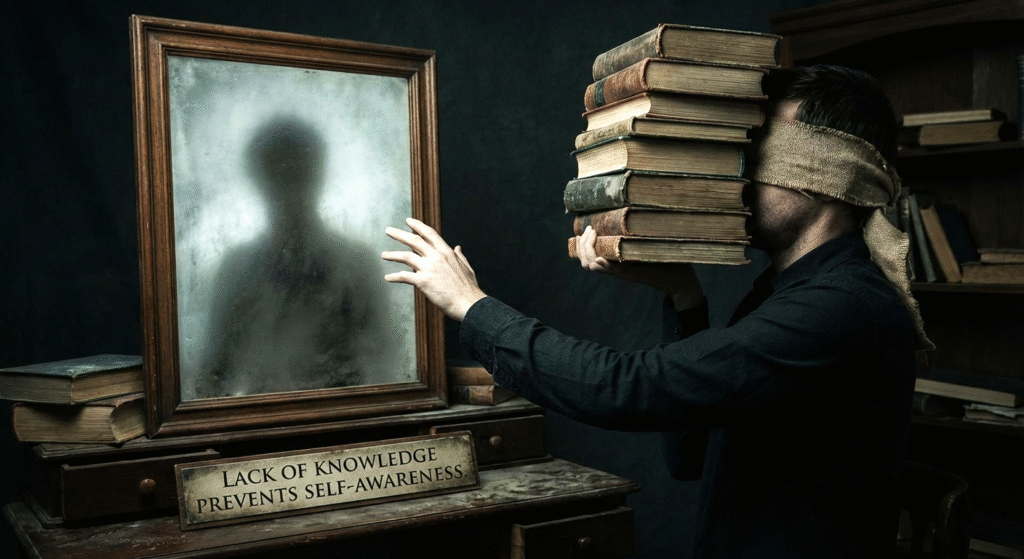
The first and most fundamental reason less knowledgeable people appear more confident is simple: they don’t know what they don’t know.
To accurately judge your own ability, you need a certain level of understanding. Ironically, the very skills required to perform well in a domain are often the same skills required to evaluate performance correctly. When those skills are missing, self-assessment becomes deeply flawed.
A person with limited knowledge:
- Cannot recognise errors in their own thinking
- Lacks benchmarks to compare themselves against experts
- Mistakes familiarity for mastery
For example, someone who has read a few social media posts about economics may feel confident enough to argue aggressively about inflation, taxation, or government policy. They don’t realise how complex economic systems are because they’ve never studied them deeply. Their confidence comes not from competence, but from ignorance of complexity.
In contrast, someone who has studied economics formally understands:
- How many variables are involved
- How uncertain predictions can be
- How often experts disagree
This awareness produces humility, not arrogance.
In short, ignorance blinds people to their own ignorance, creating an illusion of competence that feels like confidence.
2. Early Learning Creates a False Peak of Confidence

The Dunning–Kruger Effect often follows a predictable curve. At the very beginning of learning something new, confidence spikes dramatically. Psychologists sometimes call this the “Peak of Mount Stupid” (a blunt but memorable term).
Why does this happen?
When people first learn a few basic concepts:
- They feel empowered by new information
- Simple explanations make the topic seem easy
- Early success creates excitement
At this stage, knowledge is shallow, but enthusiasm is high. Because the learner hasn’t yet encountered real difficulty, they assume mastery is close.
For example:
- A beginner who learns a few gym exercises may believe they understand fitness
- A novice investor who makes quick profits may believe they’ve mastered the market
- A new language learner who memorizes basic phrases may feel fluent
This early confidence is dangerous because it discourages further learning. People think, “I already know this.” They stop asking questions. They stop listening.
As learning continues, confidence usually collapses when reality hits. Complexity appears. Mistakes increase. This drop is often called the “Valley of Despair.”
Less intelligent or less reflective individuals often never leave the false confidence stage, because they stop learning early. More capable individuals push through discomfort, eventually reaching genuine competence—but with more caution and humility.
3. Confidence Is Mistaken for Intelligence (Social Reinforcement)

Another reason less knowledgeable people appear confident is that society often rewards confidence, not accuracy.
In many social settings:
- The loudest voice gets attention
- Certainty sounds persuasive
- Doubt is mistaken for weakness
As a result, people who speak boldly—even when wrong—are often perceived as leaders, experts, or “strong personalities.” This social reinforcement strengthens their confidence further, even if it’s completely unjustified.
Meanwhile, intelligent people often:
- Use nuanced language
- Acknowledge uncertainty
- Say “I don’t know”
Ironically, this honesty can make them appear less confident, even though their understanding is deeper.
Social media makes this worse. Platforms reward:
- Simplistic opinions
- Absolute statements
- Emotional certainty
Complex, thoughtful explanations rarely go viral. This creates an environment where overconfidence is constantly rewarded, while intellectual humility is ignored.
Over time, people learn that confidence—even false confidence—brings validation. This feedback loop makes less informed individuals even more certain of themselves, regardless of truth.
4. Intelligent People Understand the Limits of Knowledge

True intelligence often brings discomfort rather than confidence. The more you know, the more you realise how much you don’t know.
This is sometimes referred to as epistemic humility—the awareness of the limits of one’s understanding.
Highly competent individuals:
- See exceptions to every rule
- Understand that knowledge evolves
- Recognise gaps in data and evidence
This leads to cautious language, careful thinking, and self-doubt. It is not because they are weak, but because they are realistic.
For example:
- A beginner may say, “This is definitely true.”
- An expert may say, “Based on current evidence, this seems likely, but more research is needed.”
To an untrained listener, the beginner sounds more confident. But in reality, the expert is being intellectually honest.
This is why many brilliant scientists, thinkers, and creators struggle with impostor syndrome—the feeling that they aren’t good enough, despite strong evidence of competence. Their deep understanding makes them acutely aware of their own limitations.
In contrast, those affected by the Dunning–Kruger Effect feel no such doubt. Their confidence is not earned—it is assumed.
5. The Dunning–Kruger Effect Is Universal, Not Just “Stupidity”

It’s important to clarify something crucial: the Dunning–Kruger Effect does not mean only “stupid” people are overconfident.
Everyone is vulnerable to it.
The effect applies to specific domains, not overall intelligence. A brilliant engineer may display Dunning–Kruger behavior when discussing psychology. A successful entrepreneur may overestimate their understanding of medicine or politics.
The key difference is that intelligent people:
- Are more willing to revise their beliefs
- Accept feedback more easily
- Continue learning after being corrected
Less reflective individuals, however:
- Defend wrong beliefs aggressively
- Interpret correction as an attack
- Double down instead of adjusting
The danger of the Dunning–Kruger Effect lies not in ignorance itself, but in the refusal to recognise ignorance.
Confidence without competence can:
- Spread misinformation
- Lead to poor decisions
- Harm others
Understanding this effect helps us become more self-aware, more open-minded, and more cautious about our own certainty.
Conclusion: True Wisdom Sounds Quiet
The reason less knowledgeable people often seem more confident is not because they are superior—it’s because their lack of awareness protects them from doubt.
The Dunning–Kruger Effect teaches us a humbling lesson:
- Confidence does not equal intelligence
- Certainty does not equal truth
- Loudness does not equal wisdom
True intelligence is often quiet, careful, and questioning. It listens more than it speaks. It understands that learning never ends.
In a world that celebrates bold opinions, choosing humility is an act of strength. Recognizing the limits of your knowledge is not weakness—it is the beginning of real wisdom.