

Why Worries Feel Stronger at Night and How to Manage Them
Have you ever noticed that a problem that seemed manageable during the day suddenly feels much bigger at night? A small worry can turn into a major concern. An old regret may return to your mind, and unfinished tasks can begin to feel overwhelming.
Many people experience this. During the day, work, family, conversations, social media, and countless activities keep our attention occupied. But when night arrives and the world becomes quieter, our thoughts often become louder.
This does not necessarily mean that our problems have become bigger. Often, it simply means that our mind finally has the time and silence to focus on them.
Let us understand the psychology behind why problems can feel more intense at night.
1. Daytime Distractions Keep Our Mind Busy
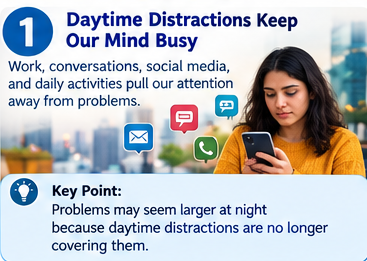
During the day, our attention is constantly moving from one thing to another. We work, talk to people, travel, use our phones, watch videos, and complete tasks.
All these activities act as distractions. They do not always solve our problems, but they temporarily pull our attention away from them.
At night, many of these distractions disappear. There are fewer people around, fewer messages, and fewer tasks demanding our attention.
As external noise decreases, internal thoughts become easier to hear.
Key Point: Problems may seem larger at night because daytime distractions are no longer covering them.
2. Silence Gives Our Mind More Space to Think
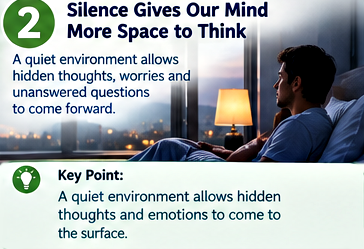
Human beings naturally reflect when the environment becomes quiet.
This is why people often think deeply while sitting alone, traveling, or lying in bed.
Night creates a peaceful environment, but that same silence can also allow worries, fears, and unanswered questions to come forward.
The mind starts reviewing conversations, decisions, mistakes, and future possibilities.
Silence itself is not the problem. It simply creates space for thoughts that were already present.
Key Point: A quiet environment allows hidden thoughts and emotions to come to the surface.
3. Unfinished Tasks Stay in Our Mind
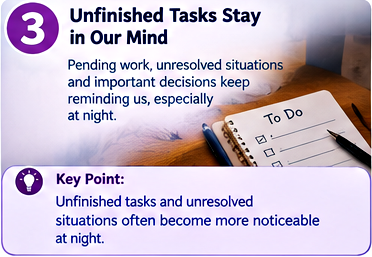
Psychologists have observed that unfinished work often remains active in our memory.
If we have unresolved problems, pending decisions, or incomplete goals, our brain keeps reminding us about them.
At night, when there are fewer distractions, these unfinished matters receive more attention.
You may suddenly remember an email you forgot to send, an argument that was never resolved, or an important decision that still needs to be made.
The mind naturally seeks closure.
Key Point: Unfinished tasks and unresolved situations often become more noticeable at night.
4. Regrets Often Return During Quiet Moments
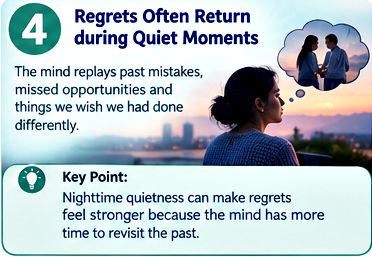
Many people replay past events in their minds at night.
They think about mistakes they made, opportunities they missed, or words they wish they had not spoken.
This happens because the mind likes to learn from past experiences. However, too much reflection can become overthinking.
Instead of learning, we start repeatedly reliving painful moments.
The past cannot be changed, but the mind sometimes keeps revisiting it in search of a different outcome.
Key Point: Nighttime quietness can make regrets feel stronger because the mind has more time to revisit the past.
5. Our Imagination Becomes More Active at Night

When we do not have complete information, our imagination fills the gaps.
At night, concerns about the future can become bigger because we start imagining possibilities.
A small health concern becomes a serious illness in our imagination. A delayed message becomes rejection. A small financial problem becomes a disaster.
During the day, reality often balances our thinking. At night, imagination sometimes becomes stronger than facts.
Key Point: Problems can grow in our mind when imagination becomes stronger than reality.
6. Mental and Physical Tiredness Can Affect Thinking
By the end of the day, our mental energy is lower.
We have already spent hours making decisions, solving problems, and dealing with responsibilities.
When people are tired, they may find it harder to think clearly and positively.
A problem that seems manageable in the morning can feel much heavier at night simply because the mind is exhausted.
This is one reason why people are often advised not to make major decisions when they are extremely tired.
Key Point: Mental fatigue can make ordinary problems feel more serious than they actually are.
7. Loneliness Can Make Thoughts Feel Stronger
Night often brings solitude.
For some people, this can be peaceful. For others, it can create feelings of loneliness.
When we feel emotionally disconnected, our worries may appear more intense because there is no immediate support or conversation to balance our thoughts.
This is especially true for people going through stress, grief, relationship problems, or major life changes.
Human beings are social, and emotional connection often reduces mental burden.
Key Point: Feeling alone can make worries seem bigger because you have less emotional support.
8. The Mind Naturally Tries to Solve Problems
Thinking itself is not bad.
The mind is designed to identify problems and search for solutions.
This ability has helped humans survive and progress.
However, productive thinking differs from endless overthinking.
Productive thinking asks:
“What can I do tomorrow?”
Overthinking asks:
“What if everything goes wrong?”
One creates solutions; the other creates stress.
Key Point: The goal is not to stop thinking, but to turn overthinking into problem-solving.
9. Not Every Night Thought Represents Reality
One important thing to remember is that thoughts are not always facts.
A tired mind, an emotional moment, or a quiet environment can change how we see things.
Many worries that feel huge at midnight seem much smaller the next morning.
This is why people often say, “Sleep on it before making a decision.”
Time, rest, and a fresh perspective can change our understanding of a problem.
Key Point: Nighttime thoughts often feel more powerful than they actually are.
10. Healthy Habits Can Reduce Nighttime Overthinking
Although occasional overthinking is normal, some habits can help reduce it:
- Write down worries before sleeping.
- Create a simple plan for unresolved problems.
- Avoid too much negative content before bedtime.
- Practice deep breathing or relaxation.
- Keep a regular sleep schedule.
- Focus on what can be controlled rather than what cannot.
These habits do not remove all problems, but they can prevent the mind from turning small concerns into large fears.
Key Point: Small daily habits can reduce nighttime overthinking and improve peace of mind.
11. Night Can Also Be a Time for Positive Reflection
Night is not only a time for worries.
It can also be a time for gratitude, learning, creativity, and self-understanding.
Many great ideas, personal insights, and life decisions come during quiet moments.
The same silence that creates worries can also create wisdom.
The difference often depends on where we choose to direct our attention.
Key Point: Quiet moments can create not only worries but also clarity and self-understanding.
Final Thoughts
If your problems seem bigger at night, remember that you are not alone. This is a common human experience.
During the day, distractions keep us busy. At night, silence allows our thoughts to become more noticeable.
This does not always mean that the problem itself has grown. Often, it means that the mind finally has the space to focus on it.
A problem can feel bigger at night simply because the mind finally becomes quiet enough to notice it.
The next time worries appear late at night, remind yourself:
“I may be tired, emotional, or overthinking right now. I will look at this problem again with a fresh mind tomorrow.”
Sometimes, rest is not avoiding a problem—it is preparing the mind to handle it better.