

How Self-Talk Affects Your Confidence, Decisions, and Mental Health
Core idea: The way you talk to yourself influences your confidence, decisions, and outcomes.
Psychology angle: Rooted in Cognitive Behavioural Theory (CBT), which explains how our thoughts, feelings, and behaviours are deeply interconnected.
1. Difference Between Positive and Negative Self-Talk
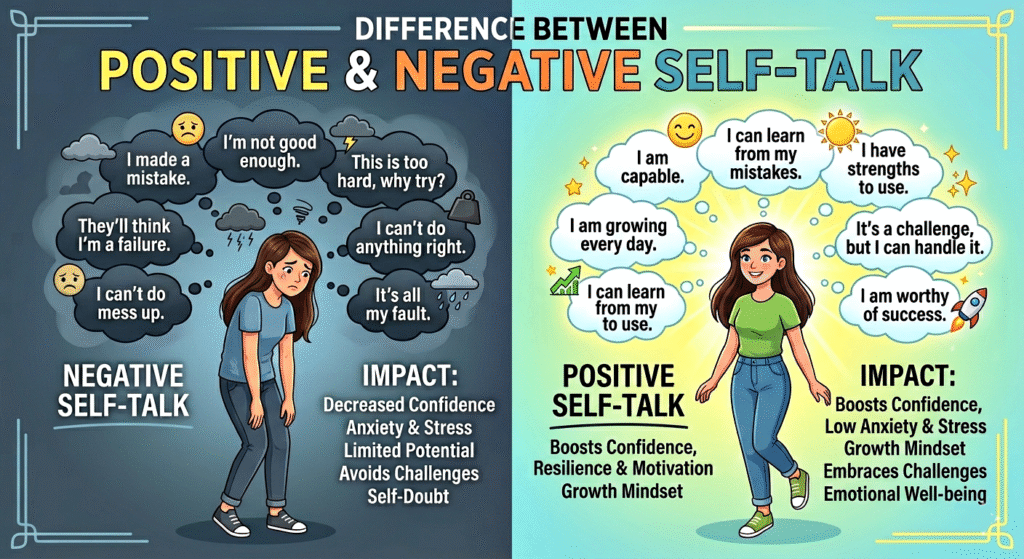
Self-talk is the continuous internal conversation we have with ourselves. It can either build us up or quietly break us down.
Positive self-talk sounds like:
- “I can handle this challenge.”
- “I may not be perfect, but I’m improving.”
Negative self-talk often sounds like:
- “I always mess things up.”
- “I’m not good enough.”
From a psychological perspective, the brain does not strongly differentiate between external and internal voices. If you repeatedly tell yourself something, your mind begins to accept it as truth. Over time, this shapes your self-image and influences how you act in real situations.
Key takeaway:
Your inner voice becomes your identity. What you repeat, you start to believe.
2. How Thoughts Influence Emotions and Behavior

According to Cognitive Behavioral Theory, thoughts are the starting point of a chain reaction:
Thought → Emotion → Behavior → Outcome
For example:
- Thought: “I’m going to fail this presentation.”
- Emotion: Anxiety, fear
- Behavior: Avoidance, lack of preparation
- Outcome: Poor performance
Now compare it with:
- Thought: “I’ll do my best and learn from this.”
- Emotion: Calm confidence
- Behaviour: Preparation and effort
- Outcome: Better performance
This shows that it’s not the situation itself, but your interpretation of it that shapes your experience.
Key takeaway:
Change your thoughts, and you begin to change your entire life pattern.
3. Cognitive Distortions and How to Challenge Them
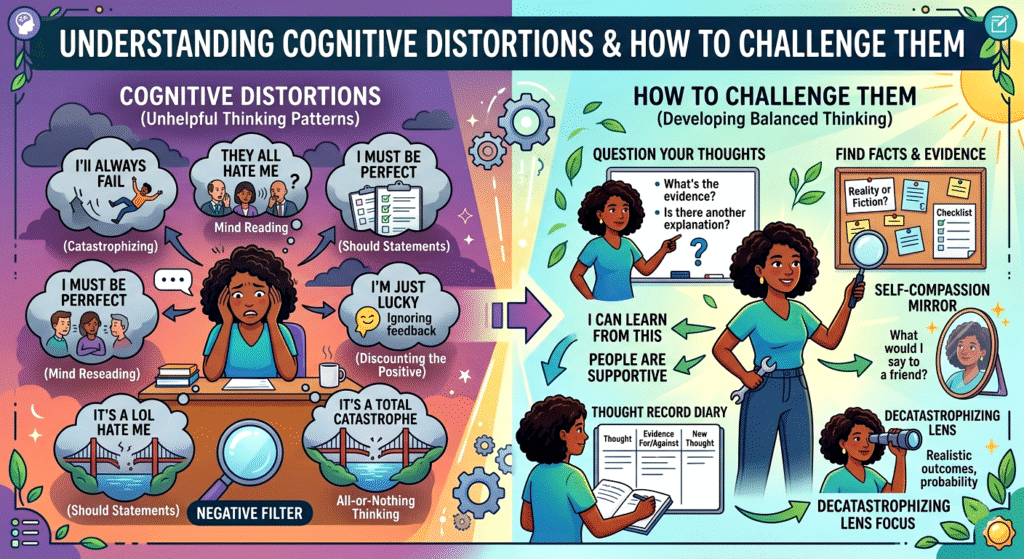
Cognitive distortions are irrational, exaggerated thought patterns that distort reality. They are a major source of negative self-talk.
Common examples include:
- All-or-nothing thinking: “If I fail once, I’m a complete failure.”
- Overgeneralization: “Nothing ever works out for me.”
- Mind reading: “They must think I’m stupid.”
- Catastrophizing: “This small mistake will ruin everything.”
To challenge these thoughts:
- Ask: Is this thought 100% true?
- Look for evidence against it
- Replace it with a balanced perspective
For instance:
Instead of “I always fail,” try:
“I didn’t succeed this time, but I can improve.”
Key takeaway:
Not every thought you have is a fact. Learn to question your mind.
4. Reframing Negative Beliefs
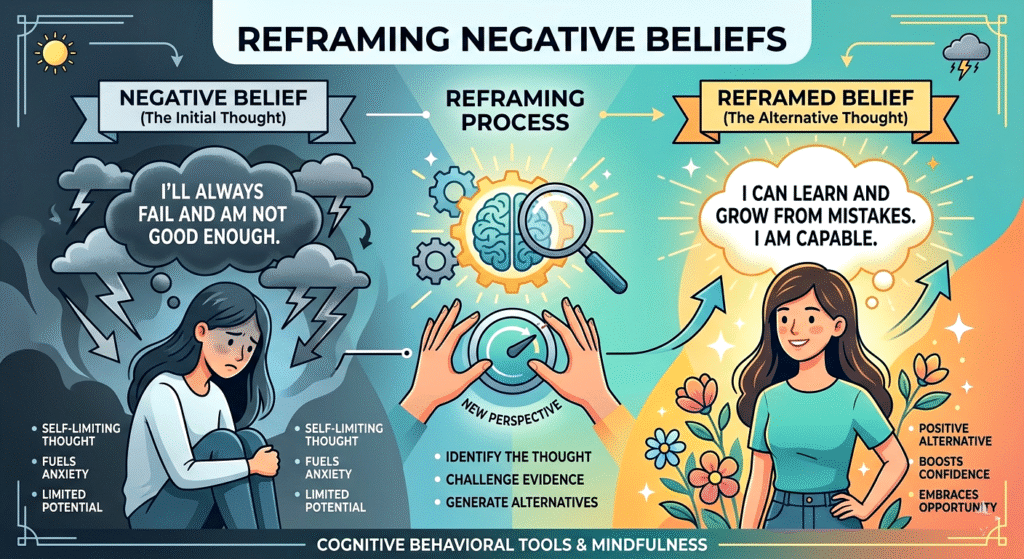
Reframing is the process of changing the way you interpret a situation or belief.
Instead of:
- “I’m bad at this,”
Try: - “I’m still learning this.”
Instead of:
- “This is a problem,”
Try: - “This is a challenge I can grow from.”
Reframing doesn’t mean ignoring reality or pretending everything is perfect. It means choosing a perspective that empowers you rather than limits you.
Psychologically, this works because the brain is adaptable. When you consistently reframe situations, you create new neural pathways that make positive thinking more natural over time.
Key takeaway:
You don’t control everything that happens, but you control how you interpret it.
5. Daily Affirmations and Mental Conditioning
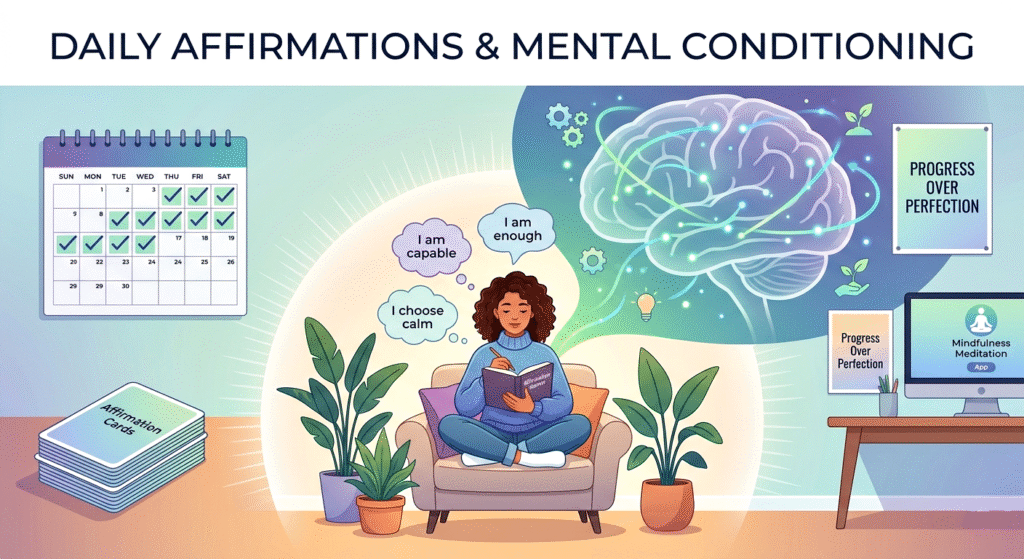
Affirmations are positive statements that you repeat to yourself to influence your mindset.
Examples:
- “I am capable and resilient.”
- “I am improving every day.”
- “I deserve success and happiness.”
At first, affirmations may feel unnatural. That’s because your brain is used to old patterns. But with repetition, these statements begin to reshape your subconscious beliefs.
For affirmations to work effectively:
- Be consistent (repeat daily)
- Say them with emotion and belief
- Combine them with action
Think of it like training your mind the same way you train your body. Consistency creates strength.
Key takeaway:
What you repeatedly tell yourself becomes your mental reality.
Conclusion
Your mind is always listening. Every thought you repeat, every word you tell yourself, is shaping your beliefs, your confidence, and ultimately your life.
The power of self-talk lies in its subtlety. It works quietly in the background, influencing your decisions, your courage, and your ability to handle challenges.
By understanding and applying principles from Cognitive Behavioural Theory, you can:
- Replace negativity with constructive thinking
- Break free from limiting beliefs
- Build a stronger, more confident version of yourself
In the end, the most important conversation you will ever have is the one you have with yourself.
Choose your words wisely—your mind is listening.