

“Don’t make yourself too much available for others.”
At first glance, this statement can sound selfish, cold, or even unkind. Society often praises constant availability—being the person who always answers calls, always helps, always listens, always sacrifices. However, when examined deeply through psychological, emotional, and practical lenses, this statement reveals a powerful truth about self-respect, boundaries, and sustainable relationships. Being too available does not make you more valuable; in many cases, it makes you taken for granted, emotionally drained, and disconnected from your own needs.
Below are five detailed points that justify and explain why you should not make yourself too much available for others, and how doing so actually leads to a healthier, stronger, and more respected life.
1. Over-Availability Reduces Your Perceived Value

Human psychology places a higher value on what is limited and less value on what is constantly accessible. This principle applies not just to material things, but also to people, time, and emotional energy.
When you are always available—replying instantly, cancelling your plans, and dropping your priorities for others—you unintentionally communicate that your time is not valued. People begin to assume that you will always be there, no matter what. As a result, your presence loses its significance. Your help is no longer appreciated; it is expected.
This does not mean people consciously decide to disrespect you. Often, it happens subtly. When something is always available, the human mind stops recognising its worth. Just like clean air is rarely appreciated until it becomes polluted, your value becomes invisible when there is no scarcity.
Healthy availability creates respect. Limited availability creates anticipation. When people know that your time must be earned, scheduled, or valued, they approach you with more consideration. They listen more carefully. They appreciate you more deeply.
Being selective about your availability is not arrogance—it is self-worth in action.
2. Constant Availability Leads to Emotional Exhaustion

Every interaction costs emotional energy. Listening, advising, helping, comforting, and supporting others—especially repeatedly—drains your internal reserves. When you make yourself too available, you slowly begin to neglect your own emotional needs.
Many people who are always available eventually experience:
- Burnout
- Emotional numbness
- Irritability
- Resentment
- Loss of enthusiasm for helping
This happens because giving without recovery is unsustainable. You cannot pour from an empty cup, yet over-available people try to do exactly that.
Ironically, the more exhausted you become, the less effective your support becomes. Your advice grows impatient. Your listening becomes mechanical. Your kindness turns into obligation. This is not because you are a bad person, but because your emotional system is overloaded.
Setting limits on availability protects your mental health. It ensures that when you do show up for others, you are present, calm, and genuine—not depleted or resentful.
True generosity comes from fullness, not exhaustion.
3. Over-Availability Encourages Dependency, Not Growth
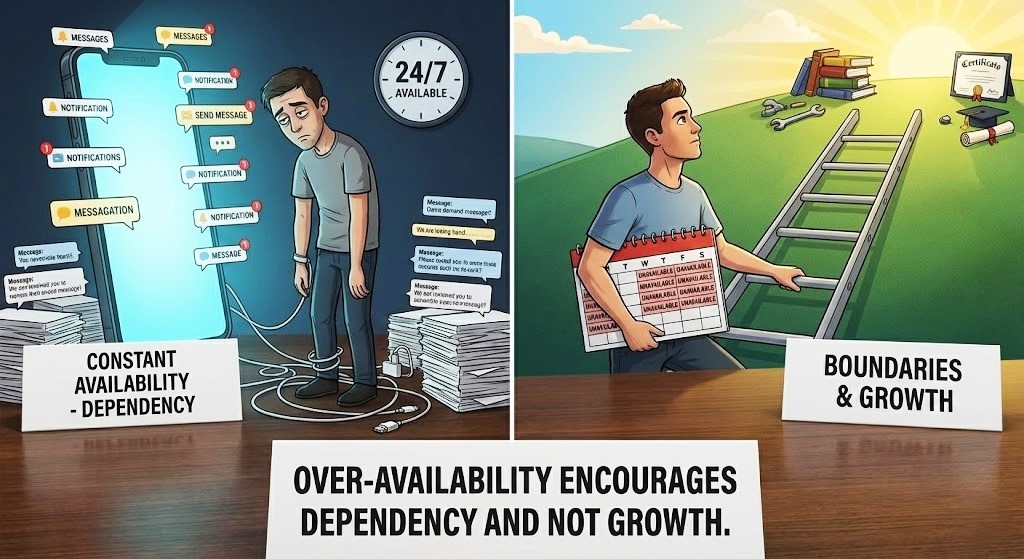
When you are always available to solve problems, give advice, or provide emotional reassurance, you may unintentionally prevent others from developing resilience and independence.
People grow by facing discomfort, making decisions, and learning from consequences. If someone always knows that you will be there to rescue them—emotionally or practically—they may stop trying to solve things on their own.
This creates unhealthy dynamics:
- Friends who only contact you when they need something
- Family members who rely on you instead of taking responsibility
- Colleagues who dump work on you because you never say no
Over time, you become less of a respected individual and more of a “support system on demand.” This is not empowerment; it is emotional dependence.
Healthy relationships involve mutual support, not one-sided availability. Sometimes, the most loving thing you can do is step back and allow others to grow. Your absence can teach responsibility, self-trust, and maturity in ways your constant presence never could.
Helping is powerful—but only when it does not replace another person’s ability to help themselves.
4. Lack of Boundaries Leads to Loss of Self-Identity

When you are too available, your life begins to revolve around other people’s needs, moods, and emergencies. Slowly, without realizing it, you start losing touch with who you are.
Your time gets filled with:
- Other people’s problems
- Other people’s schedules
- Other people’s priorities
Meanwhile, your own dreams, hobbies, goals, and rest get postponed indefinitely. You may begin to feel invisible, unfulfilled, or unsure of your own direction.
This loss of self-identity is dangerous because it breeds internal conflict. You appear helpful and calm on the outside, but inside you feel overlooked, undervalued, and disconnected. Eventually, this gap can turn into bitterness—not because people are bad, but because you never protected your inner world.
Boundaries are not walls; they are filters. They help you decide where your energy goes and where it doesn’t. When you protect your availability, you protect your identity.
You are not just here to serve others—you are here to live your own life.
5. Respect Is Built on Balance, Not Sacrifice

Many people believe that sacrifice earns respect. In reality, excessive sacrifice often earns familiarity—and familiarity, when unchecked, can erode respect.
People respect those who:
- Have priorities
- Value their time
- Can say no without guilt
- Choose, rather than react
When you make yourself less available, you teach others how to treat you. You show them that your time is not unlimited, your energy is valuable, and your presence is a choice—not an obligation.
This balance creates healthier relationships. People learn to communicate clearly, plan better, and respect your boundaries. They also feel safer knowing that when you do show up, it is because you genuinely want to—not because you feel pressured.
Respect grows where balance exists. And balance requires the courage to not always be available.
Conclusion: Availability Should Be Intentional, Not Automatic
“Don’t make yourself too much available for others” does not mean becoming cold, distant, or selfish. It means becoming conscious, intentional, and self-respecting.
Your time is your life.
Your energy is your currency.
Your presence is your power.
When you protect them, you do not lose relationships—you improve them. You become more respected, more grounded, and more fulfilled. You help from a place of strength, not obligation.
Being available is a gift.
Giving it wisely is wisdom.
In a world that constantly pulls at you, choosing when and how you show up is not selfish—it is essential.